 0
0
 0
0
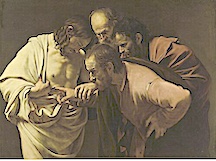
Illustration: The Incredulity of Saint Thomas by Caravaggio, c. 1602
Pope Leo’s Regina Caeli for Second Sunday of Easter
St Peter’s Square Sunday, 12 April 2026
Gospel Reading for Second Sunday of Easter (John 20:19–31)
On the evening of that day, the first day of the week, the doors being shut where the disciples were, for fear of the Jews, Jesus came and stood among them and said to them, “Peace be with you.” When he had said this, he showed them his hands and his side. Then the disciples were glad when they saw the Lord. Jesus said to them again, “Peace be with you. As the Father has sent me, even so I send you.” And when he had said this, he breathed on them, and said to them, “Receive the Holy Spirit. If you forgive the sins of any, they are forgiven; if you retain the sins of any, they are retained. Now Thomas, one of the twelve, called the Twin, was not with them when Jesus came.
So the other disciples told him, “We have seen the Lord.” But he said to them, “Unless I see in his hands the print of the nails, and place my finger in the mark of the nails, and place my hand in his side, I will not believe.”
Eight days later, his disciples were again in the house, and Thomas was with them. The doors were shut, but Jesus came and stood among them, and said, “Peace be with you.” Then he said to Thomas, “Put your finger here, and see my hands; and put out your hand, and place it in my side; do not be faithless, but believing.” Thomas answered him, “My Lord and my God!” Jesus said to him, “Have you believed because you have seen me? Blessed are those who have not seen and yet believe.” Now Jesus did many other signs in the presence of the disciples, which are not written in this book; but these are written that you may believe that Jesus is the Christ, the Son of God, and that believing you may have life in his name.
Pope Leo’s Regina Caeli
Dear brothers and sisters,
Today is the Second Sunday of Easter, which was dedicated to Divine Mercy by John Paul II
The Gospel recounts the appearance of the risen Jesus to the Apostle Thomas.
This event took place eight days after Easter, while the community was gathered.
There, Thomas encountered the Master, who invited him to look at the nail marks and put his hand into the wound in his side, and to believe.
This scene invites us to reflect on our own encounter with the risen Jesus.
Where can we find him? How can we recognize him? How can we believe?
St John, who narrated the event, gives us precise indications.
Thomas met Jesus on the eighth day, in the gathered community, and recognized him in the signs of his sacrifice.
His profession of faith, the highest in the entire Fourth Gospel, emerged from this experience: “My Lord and my God!” (v. 28).
Of course, it is not always easy to believe.
It was not easy for Thomas, and it isn’t easy for us either.
Faith needs to be nourished and sustained. For this reason, the Church invites us to gather together and celebrate the Eucharist every Sunday, the “eighth day.”
During Mass, we hear the words of Jesus, pray, profess our faith, share God’s gifts in charity, and offer our lives in union with Christ’s sacrifice.
His body and blood nourish us so that we, too, may become witnesses of his resurrection, as indicated by the term “Mass,” which means “sending forth” or “mission”.
The Sunday Eucharist is essential to the Christian life.
Tomorrow, I will depart on my apostolic journey to Africa.
The martyrs of the early African Church, especially the Martyrs of Abitene, left us a beautiful testimony in this regard.
When offered the chance to save their lives by renouncing the celebration of the Eucharist, they replied that they could not live without celebrating the Lord’s Day.
Our faith grows and is strengthened there.
Though our efforts are limited, God’s grace unites them to the actions of the members of a single body — the Body of Christ — accomplishing a single great plan of salvation that embraces all humanity.
Through the Eucharist, our hands become “the hands of the Risen One,” bearing witness to his presence, mercy, and peace.
The signs of work, sacrifice, illness, and the passing of years are often etched into our hands, as they are in the tenderness of a caress, handshake, or gesture of charity.
Dear brothers and sisters,
In a world that is in such great need of peace, we are called more than ever to be steadfast and faithful in our Eucharistic encounter with the risen Lord.
In this way, we can go forth as witnesses of charity and messengers of reconciliation.
May the Virgin Mary, blessed because she believed without seeing, help us do this.