 0
0
 0
0
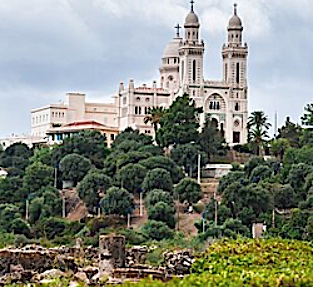
Illustration: View of the Basilica of Saint Augustine from the ruins of Hippo
Pope Leo’s homily in Basilica of St Augustine (Annaba), Algeria.
Tuesday, 14 April 2026
“I could not therefore exist, could not exist at all, O my God, unless you were in me.
Or should I not really say, “I could not exist unless I were in you” (Confessions, I, 2).
Pope Leo’s Homily in n Basilica of St Augustine (Annaba), Algeria
Dear brothers and sisters,
The Word of God pervades history and renews it through the human voice of the Savior.
Today we listen to the Gospel, the Good News for all time, in this Basilica in Annaba dedicated to St. Augustine, Bishop of the ancient city of Hippo.
Over the centuries, the places that host us have changed names, but the saints have remained our patrons and faithful witnesses to the heavenly bond with this earth.
It is precisely this dynamic that the Lord illuminated on the night of Nicodemus’s visit.
This is the strength that Christ poured into the weakness of the faith of Nicodemus and the perseverance of his search.
Jesus, sent by the Spirit of God, who “you do not know where it comes from or where it goes” was a special guest for Nicodemus. (John 3:8 – The wind blows where it wills, and you hear the sound of it, but you do not know whence it comes or whither it goes; so it is with everyone who is born of the Spirit.”),
In fact, Jesus called him to a new life, entrusting to his interlocutor — and to us as well — a surprising task: “You must be born from above” (v. 7).
This is an invitation to every man and woman who seeks salvation!
From this call of Jesus flows a mission for the whole Church, and thus also for the Christian community in Algeria: to be born again from above, that is, from God.
In this perspective, faith overcomes earthly hardships, and the Lord’s grace makes the desert bloom.
Yet the beauty of this invitation brings with it a trial that the Gospel calls us to face together.
As a matter of fact, Christ’s words contain all the force of a command: you must be born again from above!
Such a command rings in our ears as a feat that would be impossible.
However, when we listen attentively to the one who gives the order, we come to understand that this is neither a harsh imposition nor a constraint, and much less a condemnation to failure.
On the contrary, the obligation expressed by Jesus is a gift of freedom for us, because it reveals an unexpected possibility: we can be born anew from above thanks to God.
We should do so, then, according to his loving will, which desires to renew humanity by calling us to a communion of life that begins with faith.
While Christ invites us to renew our lives completely, he also gives us the strength to do so.
St. Augustine attests to this well when praying in this way, “Give, O Lord, what you command and command what you will” (Confessions, X, 29, 40).
Therefore, when we ask ourselves how a future of justice, peace, harmony and salvation will be possible, we must remember that we are asking God the same question that Nicodemus asked: can our story truly change?
We are weighed down by so many problems, hardships, and tribulations.
Can we truly start our lives over again? Yes!
The Lord’s loving response fills our hearts with hope.
No matter how weighed down we are by pain or sin, the crucified One carries these burdens with and for us.
No matter how discouraged we are by our weaknesses, it is precisely then that God manifests his strength.
He is the God who raised Christ from the dead to give life to the world.
Each one of us can experience the freedom of new life that comes from faith in the Redeemer.
St. Augustine is a prime example of this.
We revere him more for his conversion than for his wisdom.
In this rebirth, providentially accompanied by the tears of his mother, St. Monica, he found himself, exclaiming: “I could not therefore exist, could not exist at all, O my God, unless you were in me.
Or should I not really say, that I could not exist unless I were in you” (Confessions, I, 2).
Christians are truly born from above.
They are regenerated by God and become brothers and sisters of Jesus.
The Church nourishes them with the sacraments and welcomes all peoples.
As we just heard in the Acts of the Apostles, this is evident in the lifestyle described as characteristic of humanity renewed by the Holy Spirit (Acts 4:32-37).
Today, we must embrace this apostolic rule, meditating on it as an authentic criterion for ecclesial reform.
This reform must begin in the heart to be genuine and encompass everyone to be effective.
First, “the whole group of those who believed were of one heart and soul” (v. 32).
This spiritual unity is a concordia: a word that signifies well the communion of hearts that beat as one because they are united with the heart of Christ.
Therefore, the early Church, therefore, was not based on a social contract, but rather on the harmony of faith, affection, ideas and life decisions centered on the love of God who became man to save all the peoples of the earth.
Second, let us consider the tangible effects of the spiritual unity among believers: “everything they owned was held in common” (v. 32).
Everyone shares in one another’s goods as members of a single body, so everyone has everything.
No one is deprived of anything because everyone shares what they have.
Since possession can be transformed into a gift, this fraternal dedication is not a utopia. Only those with divided hearts and greedy souls believe otherwise.
On the contrary, faith in the one God, Lord of heaven and earth, unites people according to perfect justice, calling everyone to charity—that is, to love every creature with the love God gives us in Christ.
Therefore, in the face of poverty and oppression, charity is the guiding principle for Christians above all else: Do to others as you would have them do to you (Matthew 7:12).
Inspired by this law inscribed in our hearts by God, the Church continually renews itself. Where there is despair, the Church kindles hope. Where there is misery, the Church brings dignity. Where there is conflict, the Church brings reconciliation.
Third, the passage from Acts shows us the foundation of this new life that embraces people of every language and culture. “With great power, the apostles gave their testimony to the resurrection of the Lord Jesus, and great grace was upon them all” (Acts 4:33).
The charity that motivates the Apostles is more than a moral commitment; it is a sign of salvation. They proclaim that our lives can change because Christ has risen from the dead.
Therefore, the primary task of pastors as ministers of the Gospel is to bear witness to God before the world with one heart and one soul. We must not allow our concerns to lead us astray through fear nor allow trends to undermine us through compromise.
Together with you, our brothers in the episcopate and priesthood, let us constantly renew this mission for the sake of those entrusted to us. Through her service, may the whole Church be a message of new life for those we encounter.
Dear Christians of Algeria,
You remain humble and faithful signs of Christ’s love in this land.
Bear witness to the Gospel through simple gestures, genuine relationships, and daily dialogue. In this way, you bring flavor and light to the places where you live.
Your presence in this country is like incense—a glowing grain that spreads fragrance, giving glory to the Lord and bringing joy and comfort to many brothers and sisters.
This incense is a small, precious element that does not draw attention to itself but rather invites us to turn our hearts to God and encourages us to persevere amid the difficulties of the present time.
May praise, blessing, and supplication rise from the thurible of our hearts, spreading the sweet fragrance (Ephesians 5:2) of mercy, almsgiving, and forgiveness.
Your history is one of generous hospitality and resilience in times of trial.
Martyrs prayed here; St. Augustine loved his flock here, fervently seeking the truth and serving Christ with ardent faith.
Embrace this tradition and bear witness to the freedom of those born from above through fraternal charity, offering hope of salvation to the world.
The following is a fitting summary of my time here:
God is love, and he is the Father of all people.
Therefore, let us turn to him with humility and acknowledge that the current state of the world ultimately stems from our pride.
We need him, and we need his mercy.
Only in God does the human heart find peace.
Only with God can we recognize one another as brothers and sisters and walk the path of justice, integral development, and communion.
Thank you all very much!