 0
0
 0
0
Pope Leo’s homily for Third Sunday of Easter
Kilamba (Angola) – prior to pilgrimage to Our Lady of Muxima church – April 19, 2026
Luke 24:13-35
That very day two of them were going to a village named Emmaus, about seven miles from Jerusalem, and talking with each other about all these things that had happened. While they were talking and discussing together, Jesus himself drew near and went with them. But their eyes were kept from recognizing him. And he said to them, “What is this conversation which you are holding with each other as you walk?” And they stood still, looking sad.
Then one of them, named Cleopas, answered him, “Are you the only visitor to Jerusalem who does not know the things that have happened there in these days?” And he said to them, “What things?” And they said to him, “Concerning Jesus of Nazareth, who was a prophet mighty in deed and word before God and all the people, and how our chief priests and rulers delivered him up to be condemned to death, and crucified him. But we had hoped that he was the one to redeem Israel. Yes, and besides all this, it is now the third day since this happened.
Moreover, some women of our company amazed us. They were at the tomb early in the morningand did not find his body; and they came back saying that they had even seen a vision of angels, who said that he was alive.
Some of those who were with us went to the tomb and found it just as the women had said; but him they did not see.” And he said to them, “O foolish men, and slow of heart to believe all that the prophets have spoken! Was it not necessary that the Christ should suffer these things and enter into his glory?” And beginning with Moses and all the prophets, he interpreted to them in all the scriptures the things concerning himself.
Dear Brothers and Sisters,
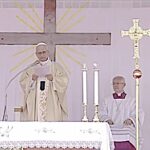
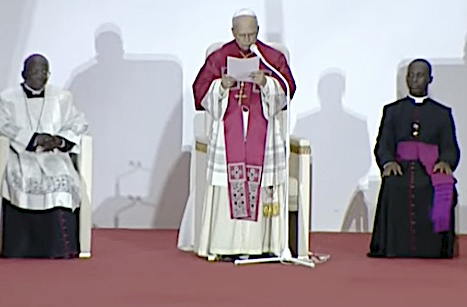
With a heart full of gratitude, I celebrate this Eucharist with you.
Thank God for this gift and thank you for your joyful reception!
On this 3rd Sunday of Easter, the Lord spoke to us through the Gospel of the disciples of Emmaus.
May this word of life enlighten us.
The two disciples, with broken hearts, left Jerusalem for their village of Emmaus.
They had placed their trust in Jesus, whom they had followed.
Now, disappointed by his death, they were returning home.
On the way, they talked to one another about all that had happened.
They needed to talk about it, to recount what they had seen and experienced.
However, there was a risk of remaining trapped in pain and closed to hope.
Brothers and sisters, in this opening scene of the Gospel I see a reflection of Angola’s history.
It is a beautiful yet wounded country that hungers and thirsts for hope, peace and fraternity.
The conversation between the two disciples, who sadly recall what happened to their Master, to mind the pain that has marked your country: the long civil war, hostility, divisions, squandered resources and poverty.
When we are immersed in a history so deeply marked by pain, for a long time, we are threatened with the same thing as the two disciples of Emmaus: loss of hope and paralyzing discouragement.
They are wandering, and yet they are stuck in the events of three days ago, when they witnessed Jesus’ death.
They talk to each other, with no hope of resolving their situation.
They continue to discuss what happened, grappling with the challenges of those who don’t know how or if they can start over.
Dear friends, the Lord’s Good News for us today is as follows: He lives and has risen.
He walks by our side as we walk the path of suffering and bitterness.
He opens our eyes so that we may recognize His work.
He gives us the grace to set out anew and rebuild the future.
The Lord joins these two disappointed and hopeless disciples.
By becoming their companion on their journey, he helps them to piece together the story.
They look beyond the pain and discover that they are not alone on this journey.
They find that a future awaits them in which the God of love is still present.
When he stops to eat supper with them, sits down at the table, and breaks bread, their eyes are opened, and they recognize him.
This is the path that has also been marked out for us, for you, dear Angolan brothers and sisters, to start anew.
On the one hand, we have the certainty that the Lord accompanies and shows us compassion.
On the other hand, we have the commitment he expects of us.
Above all, we experience the Lord’s presence at our side in our relationship with him, in prayer, and in listening to his Word, which inflames our hearts as it did the hearts of the two disciples on the road to Emmaus.
We also experience his presence in the celebration of the Eucharist.
It is here that we encounter God.
Therefore, you should be vigilant of traditional religious practices that are part of your cultural heritage but carry the risk of confusion and the incorporation of magical and superstitious elements that hinder spiritual development.
Remain faithful to the Church’s teachings, trust your pastors, and be close to Jesus, who reveals himself especially in the Word and the Eucharist.
Through these realities, we experience the Risen Lord walking beside us. United with him, we too overcome the death that surrounds us and live as the risen ones.
Knowing that we are not alone on this journey brings a sense of comfort and hope.
In fact, when the two disciples of Emmaus recognized Jesus as he broke bread for them, it meant that we must also recognize him in this way—not only in the Eucharist, but wherever life becomes broken bread and wherever someone becomes a gift of compassion like him.
Your country’s history, the difficult consequences you continue to endure, and the social and economic problems and various forms of poverty you face call for a Church that can accompany you on your journey and hear the cries of her children.
A church that, thanks to the light of the Word and the nourishment of the Eucharist, can revive lost hope. A church made up of people like you who, like Jesus breaking bread for the two disciples of Emmaus, give themselves.
Angola needs bishops, priests, missionaries, religious sisters and brothers, and lay men and women who are willing to share their lives, commit to mutual love and forgiveness, build spaces of fraternity and peace, and show compassion and solidarity to those in need.
Thanks to the grace of the risen Christ, we can become that broken bread that transforms reality.
Just as the Eucharist reminds us that we are one body and one spirit, united to the one Lord, we too can build a country where old divisions are overcome, where hatred and violence will disappear, and corruption is healed by a new culture of justice and sharing.
Only in this way can we create a hopeful future, especially for the many young people who have lost hope.
Brothers and sisters, today, we must look to the future with hope and build a hopeful future.
Do not be afraid to do so!
Jesus, who has risen and walks with you, shares with you as he would share bread. He invites you to be witnesses of his resurrection and to create a new humanity and a new society.
On this journey, dear friends, you can count on the Pope’s support and prayers.
I also know that I can count on you, and for that, I thank you.
I entrust you to the protection and intercession of Our Lady of Muxima so that she may sustain your faith, hope, and love always.