 0
0
 0
0
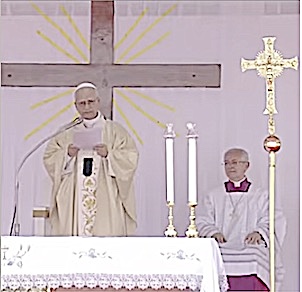
Pope Leo’s homily at Holy Mass
Esplanade in Saurimo (Saurimo) – Monday, April 20, 2026
Dear Brothers and Sisters,
The Church exists throughout the world as a community of disciples of Christ, our brother and Redeemer.
The risen Christ illuminates the path to the Father for us. With the strength of the Spirit, he sanctifies us so that we may transform our way of life in accordance with his love.
This is the Good News—the Gospel that flows through our veins like blood, sustaining us on our journey.
It is this journey that has brought me here with you today!
In the joy and beauty of our gathering, united in the name of Jesus, let us listen with open hearts to the Word of salvation so it may lead us to reflect on why we follow the Lord.
Indeed, when the Son of God became human, he performed remarkable miracles to reveal the will of the Father.
He brought light into the darkness by giving sight to the blind, gave a voice to the oppressed by loosening the tongues of the mute, and satisfied our thirst for justice by multiplying bread for the poor and weak.
Anyone who heard about these deeds set out in search of Jesus.
At the same time, the Lord looks into our hearts and asks whether we seek him out of gratitude or self-interest, calculation, or love.
In fact, he told those who were following him: “You are looking for me not because you saw signs, but because you ate your fill of the loaves” (Jn 6:26).
His words reveal those who want to consume things rather than encounter a person.
The crowd sees Jesus as a means to an end, as a provider of services.
If he had not fed them, they would not have been interested in his actions or teachings.
This happens when genuine faith is replaced by superstitious practices. In this case, God becomes an idol sought only when advantageous and for only as long as it is.
Even the Lord’s most beautiful gifts, intended for the care of his people, are misinterpreted by those who receive them and become a pretext, a prize, or a bargaining chip.
The Gospel account helps us understand the erroneous motives for seeking Christ when he is considered a guru or good luck charm.
The crowd’s motivation is also inadequate; they did not seek a teacher they loved, but rather a leader to applaud for their own advantage.
Jesus’ attitude toward us is so different.
He does not reject this insincere search, but rather, he encourages its conversion.
He doesn’t dismiss the crowd; he invites everyone to examine what stirs in their hearts.
Christ calls us to freedom. He does not want servants or clients; rather, he seeks brothers and sisters to whom he can dedicate himself completely.
In order to respond with faith to this love, it is not enough to simply hear Jesus speak; one must also accept the meaning of his words.
Nor is it enough to see what Jesus does; one must follow and imitate him.
Only when we see the will of the Savior in the sign of shared bread, who gives himself for us, do we draw closer to a true encounter with Jesus. This encounter becomes discipleship, mission, and service.
The Lord’s admonition to the crowd is transformed into an invitation: “Do not work for the food that perishes, but for the food that endures for eternal life” (John 6:27).
Through these words, Christ reveals his true gift to us. He does not ask us to disregard our daily bread, which he multiplies abundantly and teaches us to ask for in prayer.
Rather, he teaches us how to properly search for the Bread of Life—food that sustains us forever.
The crowd’s desire receives an even greater and more surprising response: Jesus does not give us food that passes away but rather bread that lasts because it is the food of eternal life.
His gift sheds light on our current situation.
Today, we can see how the hope of many people is frustrated by violence, exploited by the overbearing, and defrauded by the wealthy.
Consequently, when injustice corrupts hearts, the bread of all becomes the possession of a few.
In the face of these evils, Christ hears the people’s cries and renews our history by lifting us up from every fall, comforting us in every suffering, and encouraging us in our mission.
Just as the Eucharist is the living bread he gives us, his history knows no end.
For this reason, the risen Christ opens our lives through the power of his Spirit and removes death from our history. Christ lives! He is our Redeemer.
This is the gospel we share, making all people our brothers and sisters.
This proclamation transforms sin into forgiveness.
This is the faith that saves lives!
The Easter witness certainly pertains to Christ, the crucified one who rose again. But it also pertains to us because in him, the proclamation of our resurrection finds its voice.
We did not come into the world to die.
Nor were we born to become slaves to the corruption of the flesh or the soul. Every form of oppression, violence, exploitation, and dishonesty negates the resurrection of Christ—the supreme gift of our freedom.
This liberation from death does not only happen at the end of our lives, but every day.
What must we do to receive this gift?
The Gospel itself teaches us: “This is the work of God, that you believe in him whom he has sent” (Jn 6:29). Yes, let us believe!
Today, let us say it together with strength and gratitude to you, Lord Jesus.
We want to follow and serve you in our neighbor. Your word is our rule of life and the measure of truth.
“Blessed are those who walk in the law of the Lord” (Psalm 119:1).
This is the psalm we sang.
Dear friends, the Lord marks the path of our journey, not our needs or current trends.
For this reason, in light of our discipleship, the ecclesial journey is a “synod of resurrection and hope,” as St. John Paul II affirmed in his apostolic exhortation on Africa, Ecclesia in Africa (13).
Let us proceed in this wise direction!
With the Gospel in your heart, you will find courage in the face of difficulties and disappointments. The path God has laid out for us never fails.
Indeed, the Lord always walks with us so that we may continue on his path.
Christ himself guides and strengthens our journey. We want to learn to live this journey more and more in a synodal manner.
In this regard, the Church proclaims the Good News of Christ “not only by proclaiming the Word she has received from the Lord, but also by bearing witness to the faith, hope, and love dwelling within her disciples” (Ecclesia in Africa, 55).
By sharing the Eucharist, the bread of eternal life, we are called to serve our people with dedication, lifting up all who have fallen, rebuilding whenever violence destroys, and joyfully sharing our fraternal bonds. The initiatives of divine grace bear good fruit through us, especially in adversity.
The example of the first martyr Stephen shows us this truth (Acts 6:8-15).
Dear friends,
The witness of the martyrs and saints encourages and pushes us onto a path of hope, reconciliation, and peace. Along this path, the gift of God becomes the responsibility of the head of the household in the Christian community and civil society.
Together, guided by the Gospel, the Church in Angola grows in spiritual fruitfulness, beginning with the Eucharist and extending to the comprehensive care of individuals and communities.
The abundance of vocations you experience is a sign that you are responding to the Lord’s gift, which is abundant for those who welcome it with pure hearts.
Thanks to the Bread of Life that we share today, we can continue the journey of the entire Church, whose destination is the Kingdom of God—whose light is faith and whose lifeblood is charity.