 0
0
 0
0
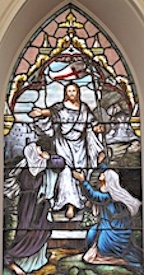
Illustration: Stained glass depiction with two Marys, Lutheran Church, South Carolina
Pope Leo’s homily for Easter Vigil in the Holy Night of Easter
“Resurrection of the Lord” –
Saint Peter’s Basilica – Saturday, 4 April 2026
Pope Leo’s homily for Easter Vigil
“The sanctifying power of this night dispels wickedness, washes faults away, restores innocence to the fallen…
drives out hatred, fosters concord and brings down the mighty” (Exsultet).
Dear brothers and sisters,
At the beginning of this celebration, the deacon began with these words, praising the light of the Risen Christ, symbolized by the Paschal Candle.
We have all lit our own candles from this single candle.
Each of us carries a small flame drawn from the same fire and has illuminated this great basilica.
This is the sign of the Paschal Light that unites us as lights for the world within the Church.
We responded “Amen” to the deacon’s announcement, affirming our commitment to embrace this mission.
Shortly, we will renew our baptismal promises, repeating our “yes.”
My dear friends,
This Vigil, the oldest in the Christian tradition and known as the “mother of all vigils,” is filled with light.
In it, we relive the Lord of Life’s victory over death and the underworld.
We participate in this celebration after recently journeying through the mysteries of the Passion of God, who became “a man of sorrows” and “despised and rejected by men” (Isaiah 53:3).
He was tortured and crucified.
Is there a greater act of charity? Is there a more complete gift?
The Risen One is the Creator of the universe who brought us into existence at the dawn of history.
He also gave his life for us on the Cross to show us his boundless love.
The first reading reminded us of this with the account of creation.
In the beginning, God created the heavens and the earth (Genesis 1:1), bringing the cosmos out of chaos, harmony out of disorder and entrusting to us – made in his image and likeness – the task of being its stewards.
Even when humanity failed to live up to that plan through sin, the Lord did not abandon us.
Instead, he revealed his merciful face to us in an even more surprising way: through forgiveness.
The “holy mystery of this night,” then, has its roots in the very place where humanity first failed, extending across the centuries as a path of reconciliation and grace.
Through the sacred texts, the liturgy has revealed some of the stages of this journey to us.
The second reading is the sacrifice of Abraham, our father in faith.
It reminded us that God stopped Abraham from sacrificing his son, Isaac, telling us that God does not desire our death but rather wants us to dedicate ourselves to being living members of the lineage of the saved (Genesis 22:11–12, 15–18).
The third reading concerns the sons of Israel went on dry ground right into the sea
Similarly, the liturgy invites us to reflect on how the Lord freed the Israelites from slavery in Egypt by transforming the sea—a place of death and an insurmountable obstacle—into a gateway to a new life of freedom.
The fourth reading is from Isaiah. your redeemer has taken pity on you
The same message was echoed in the words of the prophets, who praised God as a bridegroom who calls and gathers (Isaiah 54:5–7), a spring that quenches thirst, water that brings forth fruit (Is 55:1,10), a light that shows the way to peace (Baruch 3:14 – Learn where there is wisdom, where there is strength, where there is understanding, that you may at the same time discern where there is length of days, and life, where there is light for the eyes, and peace) and Spirit who transforms and renews the heart (cf. Ez 36:26).
Throughout the history of salvation, we have witnessed God’s response to the destructive power of sin with the transformative force of love.
Through psalms and prayers interwoven with the narrative, we are reminded that through Christ’s Paschal Mystery, “we were buried with him by baptism into death . . . we too might walk in newness of life . . . dead to sin and alive to God in Christ Jesus” (Romans 6:4, 11).
Therefore, we are consecrated in baptism to the Father’s love, united in the communion of saints, and made living stones by grace for building up his kingdom. (1 Peter 2:4–5).
In this light, let us reflect on the story of the Resurrection from the Gospel of Matthew.
On Easter morning, the women, overcoming their grief and fear, set out on their journey.
They wanted to go to Jesus’ tomb.
They expected to find it sealed with a large stone at the entrance and soldiers standing guard.
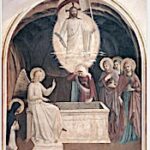
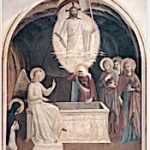
Sin is like a heavy barrier that closes us off from God and seeks to kill his words of hope within us. However, Mary Magdalene and the other Mary did not let themselves be intimidated.
They went to the tomb, and thanks to their faith and love, they became the first witnesses of the Resurrection.
They saw the power of God’s love in the earthquake and the angel sitting on the overturned stone.
God’s love is stronger than any force of evil. It is capable of “driving out hatred” and “bringing down the mighty.”
Man can kill the body, but the life of the God of love is eternal, transcending death and imprisonment by any tomb.
Thus, the crucified one reigned from the cross; the angel sat upon the stone; and Jesus appeared to them alive, saying, “Greetings!” (Matthew 28:9).
My dear friends,
This is our message to the world today.
Through the words of faith and the works of charity, we bear witness to the encounter that we sing with our lives, proclaiming the “Alleluia” with our lips.
Just as the women hurried to tell the disciples, we too should be eager to leave this basilica and share the good news that Jesus has risen.
Through his power, we too can bring forth a new world of peace and unity, despite our differences, because although there are many Christians, Christ is one.
Our brothers and sisters gathered here come from various parts of the world.
They are about to receive baptism and dedicate themselves to this mission.
After a long period of catechesis, they are reborn in Christ today, becoming new creatures (2 Corinthians 5:17) and witnesses to the Gospel.
Let us repeat to them, and to all of us, what St. Augustine said to the Christians of his time: “Proclaim Christ. Sow… Spread everywhere what you have conceived in your heart.”
Brothers and sisters, even today, there are tombs to be opened.
Often, the stones sealing them are so heavy and closely guarded that they seem immovable.
Some of these tombs weigh heavily on the human heart.
They are filled with mistrust, fear, selfishness, and resentment.
Others stem from these inner struggles and sever the bonds between us through war, injustice, and the isolation of peoples and nations.
Let us not allow ourselves to be paralyzed by them!
Over the centuries, with God’s help, many men and women have rolled them away, perhaps with great effort and sometimes at the cost of their lives.
The fruits of their labor still benefit us today.
They are not unattainable figures, but rather people like us.
Strengthened by the grace of the risen Christ, they had the courage to speak the “very words of God” and act “with the strength that God supplies” so that God may be glorified. (1 Peter 4:11)
Let us be inspired by their example.
On this holy night, let us embrace their commitment, so that the Easter gifts of harmony and peace may flourish throughout the world.