 0
0
 0
0
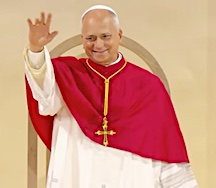
Pope Leo’s address at his PRAYER VIGIL with YOUNG PEOPLE
“Stade de France” of Saint-Denis – Friday, 25 September 2026
___________________________________
Dialogue with the Holy Father
Holy Father, we thank you for being with us this evening and for giving us this opportunity to dialogue.
Question from Chloé
My name is Chloé. I am 25 years old, and I am finishing my studies in pharmacology.
I am part of a group of young Catholics from working-class neighborhoods in the Île-de-France region called La Cité Céleste.
We organize events such as evenings of adoration and worship, which bring together many young people from the neighborhood eager to live out and share their faith.
I am also active in my parish, particularly working with high school students.
Through these activities, I am passionate about using my energy and skills to serve others and create connections between faith, youth, and daily life in our neighborhoods.
As St. Paul says, “For me, to live is Christ.”
However, the society in which we live is founded on different principles and it sometimes even seems to have no regard for the question of God.
We wish to proclaim Christ to those around us with strength and perseverance, as well as with respect and sensitivity.
How can we balance our strong missionary zeal with genuine fraternity toward those who don’t share our faith?
Pope Leo’s Response
Dear friends,
First, I would like to say one simple thing: thank you.
Thank you and thank God. Thank you for your courage, your presence, and your faith. You are the saints of France! Thank you for your question, Chloe.
The phrase from St. Paul that you quoted is more than just a statement.
It is truly the essence of his life.
In these few but decisive words, he utters a prayer of praise, an act of faith, and he points to the path of holiness that led to martyrdom. “For me, to live is Christ” (Phil 1:21).
By repeating this declaration of love, we seek to share in the Apostle’s experience.
He testifies that God was never absent from his life. God came to meet him, calling him to himself, thereby transforming him from within, and sending him out into the world.
We are all part of this spiritual journey, even today.
It is true, as you say, that the society in which we live seems indifferent to God.
But the Lord is not indifferent to us!
This is what matters, and what always gives us hope.
The fact that many are indifferent to the question of God is, indeed, a problem, but so too is the fact that many are indifferent to the question of humanity.
Sadly, how many people show no concern for their neighbors, lead selfish lives, look down on the poor while squandering their wealth on trivial things.
How many reject the weak and the infirm, thinking that a person’s worth lies solely in what they produce.
Consider your commitment in the working-class neighborhoods of Île-de-France, in La Cité Céleste: it is there, in the concrete realities of daily life, and sometimes in the midst of difficulties, that your faith becomes a vibrant witness to hope.
Humanity goes astray when it claims that God is dead.
Without God, we have no salvation and we lose the meaning of our existence, which is reduced to a dead end or to nothingness.
Conversely, those who say, “For me, to live is Christ!” experience the exact opposite. Indeed, in Christ we know that God is never indifferent to humanity!
Through Jesus, crucified and risen, God gives his own life so that we may live.
The way to proclaim Christ courageously yet respectfully is to proclaim him as the Gospel of salvation, as the word of truth and life.
The Gospel is good news for all, a liberating message, and a guide for new life.
The Gospel of Jesus does not lead to conflict but always invites us to forgive.
While shedding light on the drama of history, it fosters fraternal concern.
Encountering Christ opens the way to dialogue and prepares us for his peace, for it offers every man and woman the greatest promise, the one that fulfills our every desire, namely the promise of eternal life.
Dear Chloé, dear young people,
Every person’s religious experience expresses this search for meaning that animates the human soul.
In Jesus, the Redeemer of the world, God reveals himself by addressing “men and women as friends” (Dogmatic Constitution on Divine Revelation Dei Verbum, 2).
He is the source of living water, light in the darkness.
In the joy of faith, let us therefore proclaim together this evening: “for us, to live is Christ!” Together: for us to live is Christ!
Thanks to him, we can combine missionary zeal with the spirit of fraternity toward those who do not believe in God or who belong to other religious traditions.
This fraternity is built on listening and mutual respect and is rooted in the unity of the human family, which throughout history has expressed the religious dimension as a vital characteristic of every people.
Cultivating a fraternal bond with those who do not share our faith thus contributes to the building of society.
Furthermore, it is a way practicing faith and charity, for it is impossible to bear witness to Christ without loving those to whom we wish to proclaim him.
The meetings among young people from the Mediterranean region that have taken place in recent years are an encouraging sign of this fraternity.
The Christian message, then, is not an obstacle to fraternal coexistence; on the contrary, it promotes it by inviting everyone freely to listen to a message of peace and salvation. Similarly, our mission is not incompatible with respect for other religions, because the Church does not reject parts of them that are true and holy (cf. Declaration on the Relation of the Church with Non-Christian Religions Nostra Aetate, 2). Thank you.
Question from François
Holy Father, thank you for coming to strengthen us in our faith and in our desire to bear witness to the Gospel! My name is François Bigot.
I grew up in the countryside of Burgundy and I am currently studying agronomy at Uni La Salle.
I love dedicating my time to the beauty of the liturgy.
I also serve my Diocese of Nevers by organizing a mountain bike pilgrimage and preparing a new Burgundian pilgrimage. I am a scout leader and active in the chaplaincy ministry at my school.
We young people want to get involved in service to the most vulnerable, to peace in our country and throughout the world, to the Church of Christ!
However, it is often difficult to know how to direct our lives so that we can give of ourselves selflessly and faithfully, without becoming dispersed or losing heart, since the task sometimes seems overwhelming.
Anxiety and uncertainty often undermine the enthusiasm of our youth.
Holy Father, how can we discern where the Lord is calling us to serve and offer our lives?
The Holy Father’s Response
First of all, I would like to thank you for your commitment.
It gives me great joy to see so many of you here, driven by a desire to serve the cause of peace — a peace that helps us grow as men and women by transforming fears into hope, and complaint into responsibility.
Today, this great mission is more urgent than ever, for it calls us to navigate with discernment the current technological and digital changes, without diminishing our humanity.
In particular, when we dedicate ourselves to protecting the youngest and the most vulnerable, we recognize our personal and shared frailty.
This fragility, which is inherent in human life, does not frighten us, but unites us as creatures who discover each other as brothers and sisters in Christ.
He is the first to give himself to us, and the living sign of this grace is the Eucharist, “the source and summit of the Christian life” (Dogmatic Constitution on the Church Lumen Gentium, 11).
It is from this sacrament, which sustains our faith, that we, in turn, draw strength to give ourselves to our neighbor, imitating the selfless love of the Lord Jesus.
The pursuit of justice and peace compels us to acknowledge the conflicts we experience within ourselves and to purify our hearts.
By committing ourselves to the service of God and others, our wounds then find consolation and redemption.
Throughout the history of the world, there is no failure from which God cannot lift us up, for his mercy is our joy.
And yet, you have spoken of anxiety and uncertainty as obstacles to your enthusiasm. These are widespread feelings that arise from the uncertainty of future plans, the transient nature of emotional bonds and the fragility of relationships.
Added to these issues are others that weigh heavily on your generation, such as screen fatigue and anxiety about climate change and the international situation.
Yes, we must pay close attention to these feelings.
I invite all of you, dear young people, to keep your hearts open to the suffering of your peers.
At the same time, the experience of fragility, any kind of fragility, can become an opportunity for a disciple of Christ to bear witness.
Those who follow Jesus on the path of humble and selfless service are freed from anxiety and find new enthusiasm as they experience inner joy and peace.
These feelings are not fleeting or subjective but are rooted in the certainty of the faith to which we bear witness together as the Church.
Yes, together we form the Church: fragile and holy, like clay jars containing a treasure (2 Cor 4:7 – we have this treasure[a] in earthen vessels, to show that the transcendent power belongs to God and not to us.).
Saint Paul reminds us once again that it is precisely in weakness that we are strong (cf. 2 Cor 12:10 – For the sake of Christ, I am content with weaknesses, insults, hardships, persecutions, and calamities; for when I am weak, then I am strong.).
It is especially in difficult times that God sustains our freedom and encourages us through his grace. He chose to live as a human being so that we might live with him forever, as joyful witnesses to hope.
Dear friends,
It is in this friendship with Jesus that our discernment takes place.
It is a reflection that begins by invoking the gifts of the Holy Spirit.
It is a constant effort that enables us to continue forward in an orderly and confident manner.
How can we discern well?
Firstly, remember that the word of the Lord is always a lamp for our steps
(Psalm 119:105 – Thy word is a lamp to my feet and a light to my path.).
In the light of the Gospel, spiritual formation involves prayer and service, adoration and action, silence — rare, but necessary, far from the clamor of the media — and proclamation.
Next, draw inspiration from the example of the saints.
Even in the face of persecution, these brothers and sisters of ours opened paths of peace. Look to those priests who were passionate about Christ, such as St. Eugene de Mazenod and St. John Mary Vianney.
Look to the mystical beauty of St. Thérèse of the Child Jesus; the fervor in charity and mission of Blessed Pauline Jaricot; and the courage of the fifty martyrs of the apostolate who served their brothers and sisters even to the point of sacrificing their own lives during the Second World War.
These saints changed the course of history by leading many people from hardship to hope, since they first changed their own hearts, transforming them in the light of faith.
Dear young people,
As you discern your vocation, be assured that the Lord does not speak to us in a confusing way, but calls each of us by name, inviting us to follow him because he loves us.
If you embrace his Gospel with an open mind and a pure heart, you will understand how Jesus invites you to serve.
It is always a gift of life: full, faithful and overflowing with love.
To overcome anxiety or uncertainty, have the courage to say a simple and wonderful word: thank you. Thank you, Jesus, for your love.
That is why now, not with fear but with confidence, and full of joy, we can all say together, following the example of the saints: “Here I am, Lord!”
All together: here I am, Lord!
Now I address those among you — and there are many here tonight — who feel called to follow Jesus on the demanding path of the priesthood or consecrated life.
The Church in France needs you!
She prays for you; she awaits you.
Dear friends, do not be afraid of this call. Be bold.
Trust in Jesus, who wants to make you his closest friends.
He will not disappoint you and will always be by your side.
Your life will be beautiful and fruitful.
In conclusion, let us take up this prayer that Saint John Paul II passed on to us:
“Master, you who love and respect the human person, you who shared in humanity’s suffering, you who shed light on the mystery of human existence, help us discover the true meaning of our lives and our vocation!” (Homily at Mass for the 12th World Youth Day, Paris, 24 August 1997). Thank you!
_______________________________
In the night the light shines all the more brightly.
Thus, dear young people, we have heard together the words of Saint Paul.
We want to hold them high, like a torch that illumines not only our prayers, but the whole history of the Church.
The Apostle views his own time and receives divine inspiration, that is, the Holy Spirit, who always opens up bright prospects for the future.
Yes, God is the Lord of history, and no matter what happens, he guides its course toward salvation.
In Christ, every evil comes to an end, precisely because that end becomes the beginning of a new and eternal life.
Dear friends,
In order to shed light on our times and transform the present in the light of the Spirit, let us remember first of all that, like Timothy, we are men and women of God.
The expression “of God” used by Saint Paul, signifies a relationship, not possession. Whoever lives with God is free from everything that darkens life, rendering it empty and meaningless.
Young people of France, you carry in your hearts an immense desire for freedom, a word that resonates loudly in your culture.
But what is the source of true freedom?
Jesus clearly reveals it when he tells us that it is the truth that will set us free
(John 8:32 – you will know the truth, and the truth will make you free); and that he is the truth (John 14:6 – Jesus said to him, “I am the way, and the truth, and the life; no one comes to the Father, but by me.
The source of true freedom is a living relationship with Jesus.
The Lord’s presence brings wisdom to our plans and beauty to our heart’s desires. Like a light, God shines through our souls, inviting us to constant renewal and calling us to conversion, which gives full meaning to our lives.
Conversion makes us protagonists of a story that moves from confusion to the pursuit of truth and from indifference to commitment to justice.
St. Paul expresses this idea through three verbs that appeal to our freedom: to shun, to strive, and to fight.
To Shun
St. Paul wrote to Timothy: first of all, “shun all this,” (i.e. pride, vanity, violence, greed)
(1 Timothy 6:4 – he is puffed up with conceit, he knows nothing; he has a morbid craving for controversy and for disputes about words, which produce envy, dissension, slander, base suspicion).
(1 Timothy 6:11 “shun all this; aim at righteousness, godliness, faith, love, steadfastness, gentleness“).
These are feelings that take hold of us and possess us.
The selfishness that characterizes them conceals a frightening loneliness.
In order to experience God’s closeness and human fraternity, we must reject desires that consume our relationships without offering anything in return and fill us with things that cannot nourish us.
Such a lifestyle makes us want to have everything but become no one, receive countless “likes” but remain alone with ourselves.
To Strive
When we choose not to live that way, we begin striving for “righteousness, godliness, faith, love, patience, and gentleness” (v. 11).
Those who live with God strive for what is best and are constantly growing. They seek virtue—that inner strength which makes us good and true.
Dear friends, the dynamism that drives the Christian life is called the path of holiness.
It is the path the Lord opens for each of us and accompanies us on every step of the way.
How many sons and daughters of this beloved land of France have allowed themselves to be led along this path!
Consider Blessed Marcel Callo, for example.
He was a young Frenchman, a Boy Scout, and a worker.
In the darkness of the concentration camp, he never ceased striving toward goodness, maintaining his interior freedom.
As we progress on the path to holiness, we realize that merely shunning evil is not enough; we must actively choose good.
This is not an abstract principle nor a self-evident statement.
Choosing the good is the proper act of freedom by which freedom is realized, refined, and matured.
To make the right choices, remember this principle: The good gives life; it never takes it away.
The good cares for others; it does not take for itself.
The good is not just a nice idea, but the radiant face of love—it is God himself.
The virtues that Saint Paul indicates as reflections of God’s goodness include justice toward humanity, piety, faith in God, charity toward all, patience with those who cause us suffering, and the gentleness of those who seek peace with a pure heart.
The principles of equality and fraternity that inspire your society find their foundation here.
They are more than legal prescriptions; they are the radical and courageous choices of a free heart.
Adopting these principles is not merely a moral commitment, but a choice to become authentic individuals, free from compromise.
To Fight
In this regard, the Apostle gives us a third verb: to fight.
Indeed, shunning evil and striving for the good implies fighting.
Fight, as Saint Paul did. He is often depicted with a sword in his hand, symbolizing the word of God, “the sword of the Spirit”
(Ephesian 6:17 take the helmet of salvation, and the sword of the Spirit, which is the word of God).
This verb resonates powerfully here in France, the land of Saint Joan of Arc, a young woman who knew fought courageously.
However, remember that the battle we are called to fight is a battle of faith.
We fight it through our commitment to live according to the Gospel, as disciples of Jesus Christ, the Son of God who makes us brothers and sisters.
It is in his name that we receive the strength of the righteous to resist temptation.
It is in his name that we have the perseverance of the meek to devote ourselves to doing good. Our battle is not a battle against others.
It does not employ violence, contempt, or oppression as weapons.
Our only weapon is that of self-giving love.
Sadly, we know that there are forces opposing our relationship with God, and powers seeking to divide individuals and peoples by pitting them against one another.
These evils do not always manifest as open violence but sometimes appear in more insidious forms because they promise the very thing they take away from us: our happiness.
When we feel surrounded by their darkness, the light of the Holy Spirit enlightens us and comforts us.
So, tonight, let us choose together the virtues we must cultivate in order to follow the Lord.
We are not alone on the path to holiness.
We walk it united with our brothers and sisters around us.
You are experiencing this firsthand tonight, as happens at large gatherings like World Youth Day.
We also have the saints as our allies, who support us in times of trial. Dear friends, when life’s choices require courage, seek the saints’ intercession and follow their example.
As we sang in the litanies, the saints encourage us, assuring us that we are never alone in prayer or in the Church.
In a special way, let us ask them now to help us become peacemakers, which is God’s eternal desire for us and humanity’s constant task. Tonight, I have mentioned some of the saints. Let us also ask Saint Thérèse of the Child Jesus to teach us her “little way” of daily love, the solid foundation of every lasting peace.
The Lord realizes this peace through the covenant he establishes with us all through Jesus Christ’s mediation.
This is why, when discussing the basis of our faith, St. Paul talks about both: what we can do in response to God and what God does for us.
The apostle sums this up with the image of Jesus before Pilate: truth and love confronting hypocrisy and power.
Thus, the “good fight” coincides with the “good confession” (cf. vv. 12–13).
This is demonstrated by the use of the same adjective, kalos, which means “well done” here.
The well-done work, the good work, is the redemption that Jesus accomplishes for us. Through his struggle against sin and death,
Christ’s victory sets us free.
He saves us from all evil and invites us to all that is good.
In this light, let us consider the two relics before us — the tunic and the cross.
One was taken from Christ, and the other was given to him.
Both are symbols of his passion.
Jesus was stripped of his tunic so that he could clothe us in a white robe “washed in the blood of the Lamb” (Revelation 7:13-14 – one of the elders addressed me, saying, “Who are these, clothed in white robes, and whence have they come?” I said to him, “Sir, you know.”
And he said to me, “These are they who have come out of the great tribulation; they have washed their robes and made them white in the blood of the Lamb.).
Thus, the cross, an instrument of death, becomes a symbol of hope.
The tunic and the cross represent us as the Church born of God’s life given to the world. Dear young people, in order to grow in holiness and improve our society, be radiant witnesses to the Gospel—the good news that is Christ himself, our Savior.
“To him be honor and eternal dominion.
Amen” (1 Timothy. 6:14-16 – 14 I charge you to keep the commandment unstained and free from reproach until the appearing of our Lord Jesus Christ; 15 and this will be made manifest at the proper time by the blessed and only Sovereign, the King of kings and Lord of lords, 16 who alone has immortality and dwells in unapproachable light, whom no man has ever seen or can see. To him be honor and eternal dominion. Amen).


