 0
0
 0
0
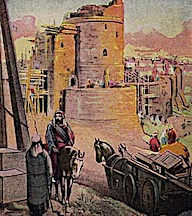
Illustration: Nehemiah: Building the Wall of Jerusalem
Pope Leo’s address to the meeting
‘Fratelli Tutti: North-South Socio-Environmental Dialogue’
Consistory Hall – Saturday, 12 September 2026
The Pontifical Commission for Latin America and CELAM, in collaboration with the USCCB, has organized the Fourth “Fratelli Tutti Synodal Encounter – North-South socio-environmental dialogue” in Rome, bringing together stakeholders from South and North America to address the social-environmental crisis in the context of the American continent.
______________
In the name of the Father, and of the Son, and of the Holy Spirit. Amen.
Peace be with you.
Your Eminences, Excellencies, and ecclesiastical authorities of the Latin American and Caribbean Episcopal Council, the Amazon Ecclesial Conference, and the United States Conference of Catholic Bishops, I cordially greet you.
I am grateful for your steadfast support of this North-South socio-environmental dialogue over the past five years, in partnership with the Pontifical Commission for Latin America.
I am also grateful for the presence and support of representatives from international organizations, regional cooperation banks, businesses, and foundations who have chosen to join us.
I also welcome the presidents, vice presidents, and general secretaries of trade union federations and employers’ chambers of the Americas, as well as the heads of ecclesial networks in Latin America and the Caribbean, organized communities in North America, and university networks in both hemispheres.
Their presence demonstrates a commitment to continuing a dialogue that can lead to more humane, sustainable, and supportive development models that protect the dignity of each person and pay particular attention to those at risk of being left behind.
This meeting is of particular interest because of the wide range of sectors represented and the significant roles that many participants play in areas crucial to social, economic, and cultural life.
For this reason, this dialogue space can help us face challenges affecting our common future more realistically.
At the beginning of my pontificate, I met with the College of Cardinals and recalled some fundamental aspects of the journey that the universal Church has followed in the footsteps of the Second Vatican Council for decades.
Among these notes, I emphasized the need for “courageous and trusting dialogue with the contemporary world in all its components and realities”
(Address to the College of Cardinals, May 10, 2025).
Such dialogue is part of the Church’s mission, entrusted by Jesus Christ to proclaim the Gospel to all peoples and bring its light to the concrete realities of each age.
Its pastoral nature commits it to facing the reality of the people to whom it is sent.
The Gospel’s imperative to care for the poor demands that this gaze be directed toward those suffering most severely from the consequences of social, economic, and technological change.
A few days ago, he recalled that the Church is called to “face reality and unmask the contradictions that characterize personal and social life in the contemporary world,” including those that accompany scientific and technological progress, which opens up unprecedented possibilities (Catechesis, September 2, 2026).
Such a commitment is rooted in the mystery of the Christian faith.
God entered into our history.
In Jesus Christ, God took on our humanity and entrusted the Church with the mission of proclaiming the Gospel amidst the real circumstances in which people live.
From the Scriptures to the great Fathers of the Church, such as St. Ambrose and St. Augustine, the Christian tradition has learned to discern within history what truly serves humanity and what turns against it.
The novelties of our time place us before a common responsibility.
In Magnificent Humanity, I expressed this idea using a biblical image: we have the opportunity to “build a new Tower of Babel or a city where God and humanity can live together” (n. 1).
Therefore, the decisive question in the face of technological development is not simply whether we accept or reject certain tools, but rather, what kind of humanity we want to build and what place each person will have in it.
A responsibility of such magnitude exceeds the capabilities of any single institution.
This is why it is necessary to embrace the logic of subsidiarity once more (cf. n. 13), recognizing the proper responsibility of each entity and the need to collaborate.
I am pleased that the Church in the Americas has created this space for interaction and collaboration to promote the North-South Shared Responsibility Agenda for Multisectoral Cooperation.
When public institutions, companies, workers, universities, communities, and social organizations share their knowledge, capacities, and resources for the common good, the conviction that has matured in the Church’s social doctrine and that my predecessors have developed in various ways takes concrete shape.
This conviction is that the great social challenges require shared responsibility, participation, and collaboration among the different bodies of society.
Pope Francis expressed this same idea when he spoke of “social friendship” (FT 154).
A shared responsibility agenda can ensure that legitimate differences do not lead to fragmentation.
In my first encyclical, I emphasized that pluralism requires a unifying principle to orient it toward common foundations and the ultimate purpose of humanity (cf. MH, 10).
The synodal experience of the Church can offer a lesson here.
Truly listening to differences does not mean diluting them but rather learning to discern them and seeking what can serve the good of all from them.
This exercise is particularly necessary in an era of polarized narratives that find immediate amplification, where confrontation can easily become an instrument of power (cf. MH, 190).
In the face of this dynamic, the mere fact that such different people and institutions have chosen to come together already carries with it a sense of responsibility.
True dialogue requires more than cordiality.
It forces us to stay engaged in the conversation when conflicting interests arise and when decisions require concrete commitments.
Moreover, for believers, fraternity ultimately stems from a truth that precedes any agreement: we have the same Father.
As Fratelli Tutti recalled, “Without openness to the Father of all, there will be no solid and stable reasons for the call to fraternity” (no. 272).
The novelties of our time have set in motion a true movement of “reflection and action” (MH, 174), which must “be guided with foresight: by institutions capable of regulating without stifling and protecting without taking over; by businesses that recognize work and dignity as measures of success; by intermediary organizations and educational communities that rebuild trust and relationships; and by citizens who cultivate responsibility, moderation, discernment, and a sense of truth” (MH, 181).
“Do not be afraid” is an exhortation that my predecessors repeated at decisive moments in the life of the Church.
I would also like to make it my own today since “we should not be intimidated by tensions or differences because they can become creative forces when guided by shared responsibility” (MH 13).
The Church’s Social Doctrine is invaluable in this regard.
Many of the organizations present here are familiar with it, studying it, and helping to spread it.
As it states in MH, 27, it “is not a handbook of principles and norms to be applied, but a process of shared discernment.”
Its principles do not replace your decisions, but rather, they provide criteria to judge whether your decisions respect human dignity and serve the common good.
Therefore, the value of any consensus reached will not be measured solely by the number of people who endorse it.
Rather, they will be recognized by the interests they protect, particularly the impact they have on the lives of the least powerful.
The principles of social justice provide a decisive criterion here.
A social, economic, and political order can be considered humane only if it enables everyone, particularly the most vulnerable, to live a dignified life without leaving anyone behind (MH, 77).
At the end of Magnificent Humanity, I reflected on the figure of the prophet Nehemiah. Faced with a ruined Jerusalem, he listened to his people’s suffering, presented it to God, discerned what needed to be done, sought the necessary resources, and organized a project that required the participation of many people (cf. MH, 241).
I would like to offer you the same image for your work.
In our time, great edifices have also come crashing down wherever progress ceases to serve people, work loses its dignity, entire communities are cast aside, and technology deepens divisions instead of helping us overcome them.
Like Nehemiah, you must “enter the construction sites of history—research laboratories, technology companies, schools, the media, institutions, and local communities—in order to rebuild what has collapsed and protect what is threatened” (MH, 241).
Furthermore, I encourage you to engage with the signs of the times, embracing the contributions of science, culture, and human experience to discern possible paths forward.
Negotiation is part of that work, and it is a “better kind of politics” that seeks the common good over particular interests (cf. FT, 154).
Therefore, I encourage you to cultivate a healthy “culture of negotiation” (cf. MH, 221), which can open paths where differences seem to block every possibility of encounter.
In this way, you will also contribute to the peace diplomacy our world needs.
Nehemiah did not rebuild Jerusalem alone.
He called upon his people, and each person worked on their assigned section.
Now it is up to you to recognize what part of this shared work has been entrusted to you. May the progress of our time not leave new ruins in its wake. May whatever we build truly be a home and refuge for all, beginning with those most in need.
Thank you very much.


