 0
0
 0
0
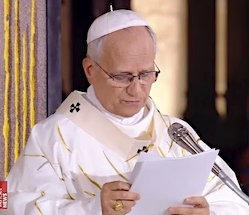
Pope Leo’s Homily at Final Holy Mass in France
Saint Stephen’s Cathedral (Metz, France) – Monday, 28 September 2026
_________________________________
First reading (Isaiah 32:14-18)
For the palace will be forsaken, the populous city deserted; the hill and the watchtower will become dens forever, a joy of wild asses, a pasture of flocks; until the Spirit is poured upon us from on high, and the wilderness becomes a fruitful field, and the fruitful field is deemed a forest.
Then justice will dwell in the wilderness, and righteousness abide in the fruitful field.
The effect of righteousness will be peace, and the result of righteousness, quietness and trust forever.
My people will abide in a peaceful habitation, in secure dwellings, and in quiet resting places
Gospel Reading (Matthew 5:38–48)
“You have heard that it was said, ‘An eye for an eye and a tooth for a tooth.’
39 But I say to you, Do not resist one who is evil.
But if anyone strikes you on the right cheek, turn to him the other also; and if anyone would sue you and take your coat, let him have your cloak as well; and if anyone forces you to go one mile, go with him two miles.
Give to him who begs from you, and do not refuse him who would borrow from you.
“You have heard that it was said, ‘You shall love your neighbor and hate your enemy.’
But I say to you, love your enemies and pray for those who persecute you, so that you may be sons of your Father who is in heaven; for he makes his sun rise on the evil and on the good, and sends rain on the just and on the unjust.
For if you love those who love you, what reward have you?
Do not even the tax collectors do the same?
And if you salute only your brethren, what more are you doing than others?
Do not even the Gentiles do the same?
You, therefore, must be perfect, as your heavenly Father is perfect
Pope Leo’s Homily,
Dear brothers and sisters,
I am pleased to preside over this Eucharistic celebration, during which we entrust the diocesan community of Metz and all of Europe to the Lord.
In this historic Moselle region, which has always been a crossroads for different peoples and has suffered because of its location on Europe’s frontier, God’s promise resounds today with extraordinary power.
In the first reading (Isaiah 32:15-18), the prophet Isaiah describes the arrival of the Kingdom of God in terms of righteousness, justice and peace.
He uses three images: the desert, the garden and the house.
In the desert — a place of sobriety and silence — justice is established; or the law that helps people to walk in the path of goodness.
This austere image reminds us of the importance of simplicity and what is essential.
It allows us to assign the proper value to things, while teaching us renunciation and sacrifice.
The second image is that of a garden where justice reigns.
While the desert represents the essential, the garden represents beauty.
Water is present, seeds sprout, shoots emerge, and flowers bloom, each with their own particular beauty.
This is the effect of a righteous life, which allows a person to flourish by freely following the Lord’s plans..
The third image is that of a house, a place of peace.
While the desert and the garden are settings where God’s action prevails, causing things to sprout and grow, building a house, on the other hand, requires a more direct and significant contribution from human beings.
Building a house involves applying strength and skill through shared effort — a true “construction project.”
Similarly, peace, a gift from God, requires a response from human beings through combined human effort.
After all, a home is more than just a stone structure.
It is a place of human presence and love.
In this sense, the prophet’s words remind us that harmony can only be built through charity in a world marked by limitations.
Charity knows how to share joys and sorrows, encourage and forgive, without calculation or limit, just as in a family.
The Gospel we have just heard also addresses this (Mt 5:38–48).
In a world marked by violence, manipulation and arrogance, Jesus teaches us to transform deserts into oases, to plant gardens, and to build homes.
He shows us the path of forgiveness, mercy and magnanimity: “If anyone strikes you on the right cheek, turn the other also; and if anyone wants to sue you and take your coat, give him your cloak as well; and if anyone forces you to go one mile, go also the second mile” (Matthew 5:39–41).
To some, these words may seem like a sign of weakness, or a concession to evil, but that is not the case.
Let us take a careful look at ourselves and our surroundings.
What do attitudes such as vengeance, retaliation, and rejection bring about in the world and within ourselves?
What kind of future do relationships and systems imbued with the ruthless mentality stemming from these attitudes hold for humanity?
Those of you, who are the children of a land torn apart by fratricidal conflicts in the past, know full well that those who seek revenge are not stronger than those who forgive.
Those who refuse to yield are not stronger than those who seek reconciliation.
The idea that those who walk away are stronger than those who face challenges together is a myth.
The regions of Metz and Moselle bear witness to the world that reconciliation is possible only when one has the courage to break free from the chains of resentment.
It takes strength and integrity to not be overwhelmed by evil, especially when the wounds inflicted are deep.
However, when faced with injustice, humanity’s only path to salvation is to love others and trust them regardless of the circumstances, even when confronted with difficult behavior (Matthew 5:42).
Thus, law, justice, and peace are steps in a process of conversion that starts as an individual journey and grows into a communal one, resulting in a civilization that respects human beings and their Creator.
It is no coincidence that Saint Augustine defined the peace of the heavenly city as a harmonious communion in which people find joy in God and in one another through him (cf. De Civitate Dei, XIX, 13, 1).
Augustine also described peace among people as the fruit of tranquillitas ordinis, (the tranquility of order) whereby each person recognizes and respects the unique and sacred dignity and role of others.
Here in Metz, it is worth recalling that the Europe we know today was built on these very values over the centuries.
Its spiritual and moral heritage predates its economic and political heritage.
As Saint John Paul II emotionally recalled, these values have their roots in the lives and deeds of men and women who lived, preached, and shared the teachings of the Gospel (cf. Address at the Pro-EU Event, Santiago de Compostela, November 9, 1982).
Evidence of this can be seen in the great spiritual, cultural, agricultural, and artisanal contributions that monasticism has made to the continent’s history.
It can also be seen in the work of saints such as Chrodegang, the tireless shepherd of this community.
Indeed, he gave visible form to ecclesial communion in the Rule of the Canons in this very place.
The moral principles that govern our world were handed down to us.
The primacy of the person, the sacred and inviolable nature of human life under all circumstances and at all stages, the protection of individual freedom, the importance of the family as the foundation of society, caring for the poor and disadvantaged, welcoming strangers, and respecting the elderly.
Your local church, which preserves the unique legacy of a fruitful dialogue between civil society and faith.
Because of its special status, it is responsible for being a living laboratory of this fidelity.
Remaining faithful to these principles has never been easy, even for our ancestors. Nevertheless, through faithfulness and perseverance, our ancestors bequeathed these principles to us as treasures to pass on to future generations.
The magnificent cathedral in this city, where we gather today, illustrates this point very well.
Thanks to its 6,500 square meters of stained-glass windows depicting biblical scenes, it is known as the “Lanterne du Bon Dieu.”
The builders minimized the walls, which remain solid, so light could abundantly flood in for the faithful.
Anyone who enters is immersed in a rich “Biblia Pauperum,” a source of prayer and meditation through reflections of a thousand colors.
In this place of light, the historic stained-glass windows’ splendor has recently been enhanced by Marc Chagall’s genius.
The works of this great Jewish painter, set into the cathedral’s walls, transform the “Lanterne du Bon Dieu” into an extraordinary symbol of ecumenism and interreligious dialogue.
The cathedral teaches us that God’s light does not erase our unique identities, but rather unites different histories and cultures into one magnificent mosaic of peace, which is so necessary in our time of new divisions and conflicts.
Contemplating these stained-glass windows teaches us that Europe’s future lies not in uniformity but in the harmony of differences, where the wounds of the past become openings through which light shines.
This is a symbol of our identity as the Church.
Like them, we make use of structures that only have meaning insofar as they help us bring the light of the Gospel to the world.
Without the stained-glass windows, the windows of Saint Stephen’s Cathedral would merely be spaces flooded with blinding light.
With these windows, however, they become “books” that bring us together to remember stories full of heroism, goodness, mercy, love, and moral beauty.
We must be generous and courageous witnesses to these stories.
With gratitude and trust as my trip to France draws to a close, this is the wish I share with you for the community in Metz, which today more than ever is called to be a beacon of hope for this country, for Europe and for the world.
I entrust this to the intercession of the Virgin Mary and your patron saints.


