Due to shortage of content, due to holiday period, we researched back to Pope Benedict’s famous address to the Bishops of Latin America and the Carribean. His content is comprehensive!
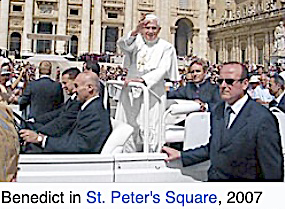
Address of Pope Benedict XVI to the inaugural session of the
Fifth General Conference of the bishops of Latin America and the Caribbean
Conference Hall, Shrine of Aparecida – Afternoon of Sunday, 13 May 2007
Theme: “Disciples and Missionaries of Jesus Christ, so that our peoples may have life in him”.
Dear Brother Bishops, beloved priests, religious men and women and laypeople,
Dear observers from other religious confessions:
1. The Christian faith in Latin America
For more than five centuries, faith in God has shaped the life and culture of these nations.
The encounter between this faith and indigenous peoples has given rise to the continent’s rich Christian culture, expressed through art, music, literature, and, most importantly, religious traditions and the people’s way of life.
Despite the diversity of cultures and languages, a shared history and creed unite them, giving rise to a great underlying harmony.
Currently, this faith faces serious challenges because the harmonious development of society and the Catholic identity of these peoples are in jeopardy.
In this regard, the Fifth General Conference will reflect on this situation to help the Christian faithful live their faith with joy and coherence.
The conference will also aim to deepen their awareness of being disciples and missionaries of Christ, sent by him into the world to proclaim our faith and bear witness to our love.But what did accepting the Christian faith mean for the nations of Latin America and the Caribbean?
For them, it meant recognizing and embracing Christ as the unknown God that their ancestors sought in their rich religious traditions, albeit unknowingly.
They were silently longing for Christ, their Savior.
It also meant that they received the divine life that made them children of God by adoption in the waters of baptism.
Moreover, they received the Holy Spirit, who came to purify and develop their cultures, making them fruitful and guiding them along the paths of the Gospel.
In effect, the proclamation of Jesus and his gospel did not involve the alienation of pre-Columbian cultures nor the imposition of a foreign culture.
Authentic cultures are not closed off from the outside world.
Nor are they set in stone at a particular point in history
Rather, they are open to encountering other cultures.
They hope to achieve universality through encounters and dialogue with different ways of life.
They also hope to achieve this through elements that can lead to a new synthesis. In this synthesis, the diversity of expressions and their particular cultural embodiment are always respected.
Ultimately, only truth can bring unity, and love is the proof of this.
Christ is not alien to any culture or person because he is the incarnate Logos who “loved to the end.”
The response he seeks from cultures gives them their ultimate identity, uniting humanity while respecting diversity.
This opens people everywhere to growth in genuine humanity and authentic progress.
In becoming flesh in Jesus Christ, the Word of God also became history and culture.
The utopian idea of reviving the pre-Columbian religions and separating them from Christ and the universal Church would not be a step forward; it would be a step backward.
In reality, it would be a retreat to a historical period anchored in the past.
Fortunately, the wisdom of the indigenous peoples led them to synthesize their cultures with the Christian faith that the missionaries offered them.This resulted in the rich and profound popular religiosity that we see today, which
– Love for the suffering Christ, the compassionate God of pardon and reconciliation who loved us so much that he handed himself over for us.
– Love for the Lord present in the Eucharist, the incarnate God who died and rose again to become the bread of life.
– the God who is close to the poor and to those who suffer;
– profound devotion to the Most Holy Virgin of Guadalupe, also known as the Virgin of Aparecida, who is invoked under various national and local titles.
When the Virgin of Guadalupe appeared to Saint Juan Diego, a native Indian, she spoke these important words to him:
“Am I not your mother? Are you not under my shadow and my gaze? Am I not the source of your joy? Are you not sheltered underneath my mantle, under the embrace of my arms?” (Nican Mopohua, nos. 118-119).
This religiosity is expressed through devotion to the saints and their feasts, love for the Pope and other pastors, and love for the universal Church as the great family of God. The Church must never leave her children alone or destitute.
Together, these form the great mosaic of popular piety, a precious treasure of the Catholic Church in Latin America that must be protected, promoted, and purified when necessary.
2. Continuity with the other Conferences
The Fifth General Conference is being held as a continuation of the previous four conferences in Rio de Janeiro, Medellín, Puebla, and Santo Domingo.
In the same spirit, the bishops now wish to reinvigorate evangelization so that these peoples may continue to grow and mature in their faith. They hope to inspire them to be the light of the world and witnesses to Jesus Christ through their lives.
Following the Fourth General Conference in Santo Domingo, many changes occurred in society.
The Church, which shares in the achievements, hopes, sufferings, and joys of her children, wishes to walk alongside them during this challenging time to inspire hope and comfort. (cf. Gaudium et Spes, 1).
Today, globalization is experienced as a network of relationships across the planet.
From certain points of view, globalization benefits the human family and is a sign of its profound aspiration toward unity.
Nevertheless, it also brings the risk of vast monopolies and treating profit as the supreme value.
As with all areas of human activity, globalization must also be guided by ethics, placing everything at the service of the human person, who is created in the image and likeness of God.
There has been notable progress towards democracy in Latin America and the Caribbean, as well as in other regions.
However, there are grounds for concern in the face of authoritarian forms of government and regimes wedded to ideologies that we thought had been superseded. These ideologies do not correspond to the Christian vision of man and society as taught by the Social Doctrine of the Church.
On the other hand, the liberal economies of some Latin American countries must consider equity because immense poverty and the despoiling of natural resources oppress large sectors of society.
Ecclesial communities in Latin America have a notable degree of faith maturity among their active lay men and women devoted to the Lord.
There are also many generous catechists, young people, and new ecclesial movements, as well as recently established Institutes of consecrated life.
Catholic initiatives in education, charity, and housing have proven essential.
It is true, however, that one can detect a weakening of Christian life and participation in the Catholic Church due to secularism, hedonism, indifferentism, and proselytism by numerous sects, animist religions, and new pseudo-religious phenomena.
These developments constitute a new situation that will be analyzed at the Fifth Conference in Aparecida.
Faced with new and difficult choices, the faithful look to this Fifth Conference for renewal and revitalization of their faith in Christ, our one teacher and savior, who revealed to us the infinite love of God the Father for humanity.
New paths and creative pastoral plans will emerge from this source, capable of instilling firm hope in living out the faith joyfully and responsibly and spreading it in one’s surroundings.
3. Disciples and Missionaries
This General Conference has as its theme: “Disciples and Missionaries of Jesus Christ, so that our peoples may have life in him”.
The Church is entrusted with the important responsibility of safeguarding and nurturing the faith of the People of God. It is also charged with reminding the faithful on this continent that they are called to be disciples and missionaries of Jesus Christ by virtue of their baptism.
This means following him, living intimately with him, imitating his example, and bearing witness.
Like the Apostles, every baptized person receives the missionary mandate from Christ. “Go into all the world and preach the Gospel to all creation. Whoever believes and is baptized, will be saved” (Mark 16:15).
Being disciples and missionaries of Jesus Christ and seeking life “in him” presupposes being deeply rooted in him. What does Christ give us?
Why do we want to be his disciples?
The answer is that we hope to find true life in communion with him.
Thus, we want to make him known to others and share the gift we have found in him.
But is that really true?
Are we truly convinced that Christ is the way, the truth, and the life?
In light of the priority of faith in Christ and life “in him,” as stated in the title of this Fifth Conference, a further question could arise:
Could this priority lead to emotionalism and religious individualism?
Is it an abandonment of the urgent reality of the significant economic, social, and political issues in Latin America and around the world?
Could it be an escape from reality into a spiritual world?
As a first step, we can answer this question with another:
What is this “reality”? What is real?
Are only material goods and social, economic, and political issues “real”?
The dominant tendencies of the last century made this great error, a destructive one as evidenced by the results of Marxist and capitalist systems. They falsify the notion of reality by detaching it from God, the fundamental and essential reality. Anyone who excludes God from their worldview falsifies the notion of reality and will inevitably end up at a dead end or with destructive solutions.
The first basic point to affirm is that only those who recognize God understand reality!
We can respond to it in an adequate and truly human manner.
This thesis is evident in the collapse of systems that marginalize God.
Yet the question immediately arises: Who knows God? How can we know Him?
We cannot engage in a complex discussion of this fundamental issue here.
For a Christian, the crux of the response is simple.
Only God knows God.
Only His Son, who is God from God and true God, knows Him.
“He who is nearest to the Father’s heart has made Him known.”
(John 1:18 – No one has ever seen God;
the only Son, who is in the bosom of the Father, he has made him known).
This is why Christ is so important to us and to humanity.
Without knowing God through Christ, reality becomes an indecipherable enigma.
Without Him, there is no life or truth.
God is foundational reality—not a hypothetical or imagined god, but a god with a human face. He is God with us, the God who loves us to the cross.
When a disciple understands Christ’s love “to the end,” he cannot help but respond with similar love
“As they were going along the road, a man said to him, “I will follow you wherever you go.” (Luke 9:57).
We can ask ourselves another question: What does having faith in this God offer us?
First, it gives us a family: the universal family of God in the Catholic Church.
Faith releases us from the isolation of the “I” by leading us to communion.
Encountering God means encountering our brothers and sisters.
It is an act of convocation and unification.
It is also an act of responsibility toward others.
In this sense, the preferential option for the poor is implicit in the Christological faith.
The faith is in the God who became poor for us so that we may be enriched by his poverty
(2 Corinthians 8:9 For you know the grace of our Lord Jesus Christ, that though he was rich, yet for your sake he became poor, so that by his poverty you might become rich).
Before considering the implications of our faith in God becoming man, we must explore a deeper question:
How can we truly know Christ in order to follow him, live with him, find life in him, and share that life with others, society, and the world?
Above all, Christ reveals himself to us through the Word of God, which includes his person, life, and teachings.
As the missionary Church of Latin America and the Caribbean prepares to enter a new phase with the Fifth General Conference in Aparecida, having a profound knowledge of the Word of God is essential.
To achieve this, we must teach people to read and reflect on the Word of God.
It should become their staple diet, allowing the faithful to see through their own experience that the words of Jesus are spirit and life.
(John 6:63 – It is the spirit that gives life, the flesh is of no avail; the words that I have spoken to you are spirit and life.).
Otherwise, how could they proclaim a message whose content and spirit they do not fully understand?
We must build our missionary commitment and our entire lives on the foundation of God’s Word.
For this reason, I encourage bishops to make this clear.
An important way to introduce the People of God to the mystery of Christ is through catechesis.
Here, the message of Christ is conveyed straightforwardly and substantially.
Therefore, it is crucial to reinforce catechesis and faith development for children, young adults, and adults.
Reflecting deeply on one’s faith illuminates the path of life and strengthens one’s ability to bear witness to Christ.
Most valuable tools with which to achieve this are the Catechism of the Catholic Church and its abridged version, the Compendium of the Catechism of the Catholic Church.
In this area, we should not limit ourselves to homilies, lectures, or Bible or theology courses.
We should also use the media, such as the press, radio, television, websites, and forums, to effectively communicate the message of Christ to a large audience.
As we strive to understand and apply the message of Christ to our lives, we must remember that evangelization has always been about promoting the human person and achieving authentic Christian liberation.
“Love of God and love of neighbor have become one.
In the least of our brothers and sisters, we find Jesus himself, and in Jesus, we find God.” (Encyclical Letter Deus Caritas Est, 15).
For this reason, social catechesis and adequate training in the Church’s social teachings are also necessary.
The Compendium of the Social Doctrine of the Church is a useful tool for this purpose.
The Christian life is expressed through personal, social, and political virtues.
Founded upon the rock of God’s word, the disciple is driven to share the Good News of salvation with his brothers and sisters.
Discipleship and mission are like the two sides of a single coin.
When a disciple is in love with Christ, he cannot stop proclaiming to the world that salvation is found only in Him.
(Acts 4:12 –there is salvation in no one else, for there is no other name under heaven given among men by which we must be saved.”).
Essentially, the disciple knows that without Christ, there is no light, hope, love, or future.
4. “So that in him they may have life”
The people of Latin America and the Caribbean have the right to live lives worthy of children of God, free from hunger and violence, and under more humane conditions.
To this end, their bishops must promote a culture of life, as my predecessor Paul VI said, “so that they may pass from misery to the possession of necessities, to the acquisition of culture, to cooperation for the common good, and to the acknowledgment of supreme values and of God as their source and their end.”
(Populorum Progressio, 21).
This papal document emphasizes that authentic development must be integral, meaning it should promote the well-being of every person (cf. no. 14).
It also calls on everyone to overcome significant social inequalities and disparities in access to resources.
Above all, these people yearn for the fullness of life that Christ brought us. “I came that they may have life and have it abundantly.” (John 10:10).
This divine life fully develops human existence in its personal, familian, social, and cultural dimensions.
In order to form disciples and support missionaries in their great tasks, the Church provides them with the Bread of the Word and the Bread of the Eucharist.
In this regard, we find inspiration and illumination in the Gospel passage about the disciples on the road to Emmaus.
When they sit at the table and receive the blessed, broken bread from Jesus Christ, their eyes are opened.
They recognize the face of the risen Lord and feel in their hearts that all he said and did was true.
They know that the redemption of the world has begun.
Every Sunday and every Eucharist is a personal encounter with Christ.
As we listen to God’s Word, our hearts burn because he is the one proclaiming it.
When we break the bread at the Eucharist, we receive him personally.
The Eucharist is indispensable nourishment for the life of a disciple and missionary of Christ.
Sunday Mass is the Center of Christian life
Hence the need to prioritize appreciation of its importance in pastoral programs.
We must motivate Christians to actively participate and bring their families, if possible.
Participating in Sunday Mass with their children is an effective way for parents to teach their children the faith and strengthen the bond between them.
Throughout the Church’s history, Sunday has been the privileged moment of the community’s encounter with the risen Lord.
Christians should be aware that they are not following a historical figure, but the living Christ who is present in their lives today.
He walks alongside us, revealing the meaning of events, suffering, death, rejoicing, and feasting.
He enters our homes and remains there, feeding us with the bread of life.
For this reason, Sunday Mass must be at the center of Christian life.
Encountering Christ in the Eucharist inspires a commitment to evangelization and solidarity.
It awakens in Christians a strong desire to proclaim the Gospel and bear witness to it in the world, building a more just and humane society.
From the Eucharist, an immense wealth of charity, sharing in the difficulties of others, love, and justice has sprung forth over the centuries.
Only from the Eucharist will a civilization of love spring forth, one that will transform Latin America and the Caribbean into not only the Continent of Hope but also the Continent of Love!
Social and Political problems
Now that we have arrived at this point, we should ask ourselves: How can the Church contribute to solving urgent social and political problems and respond to the great challenges of poverty and destitution?
The problems in Latin America and the Caribbean, like those in the rest of the world, are multifaceted and complex. They cannot be solved with generic programs.
The fundamental question of how the Church, guided by faith in Christ, should respond to these challenges concerns us all. In this context, we inevitably speak of the problem of unjust structures.
Just structures are a prerequisite for a just society.
But how do they arise? How do they function?
Both capitalism and Marxism promised to establish just structures.
They claimed these structures would function independently and promote a communal morality, rendering individual morality unnecessary.
This ideological promise has been proven false.
The facts have clearly demonstrated this.
Where the Marxist system found its way into government, it left behind a sad legacy of economic and ecological destruction and painful oppression.
We can see the same thing happening in the West, where the gap between rich and poor is constantly growing and giving rise to a worrying degradation of personal dignity through drugs, alcohol, and deceptive illusions of happiness.
As I have said, just structures are an indispensable condition for a just society.
However, they neither arise nor function without a moral consensus in society on fundamental values and the necessity of making sacrifices for these values, even if it goes against personal interests.
Without God—God with the human face of Jesus Christ—these values fail to manifest their full force, and a consensus concerning them does not arise.
I am not saying that non-believers cannot live a lofty and exemplary morality.
However, I am saying that a society without God will not find the necessary consensus on moral values or the strength to live according to these values, even when they conflict with private interests.
On the other hand, just structures must be sought and developed in light of fundamental values, with the full engagement of political, economic, and social reasoning.
These structures are a matter of recta ratio and do not stem from ideologies or their premises.
There is certainly a wealth of political experience and expertise regarding social and economic issues that can highlight the fundamental elements of a just state and the paths to be avoided.
However, amid constant technological developments and changes in the world’s historical reality, adequate answers must be sought rationally and a consensus must be created on the necessary commitments to establish these structures.
This political task is beyond the Church’s immediate competence.
Respect for a healthy secularity, including pluralism of political opinions, is essential to the Christian tradition.
If the Church were to transform itself into a political entity, it would do less for the poor and justice because it would lose its independence and moral authority by identifying with a particular political path and debatable partisan positions.
The Church advocates for justice and the poor precisely because she does not identify with politicians or partisan interests.
Only by remaining independent can she teach great principles and inalienable values, guide consciences, and offer choices in life that transcend the political sphere.
Forming consciences, advocating for justice and truth, and educating in individual and political virtues are the Church’s fundamental vocations in this area.
Lay Catholics must be aware of their responsibilities in public life and be present in forming the necessary consensus and opposing injustice.
Just structures will never be completely defined.
As history evolves, these structures must be constantly renewed and updated.
They must always be imbued with a political and humane ethos, and we must work hard to ensure its presence and effectiveness.
In other words, the presence of God, friendship with the incarnate Son of God, and the light of his word are fundamental to the presence and efficacy of justice and love in our societies.
As a continent of baptized Christians, it is time to overcome the notable absence of Catholic leaders with strong personalities and generous dedication in the political sphere, the media, and universities.
These leaders must be coherent in their ethical and religious convictions and take initiative.
Ecclesial movements have ample opportunity to remind the laity of their responsibility to bring the light of the Gospel into public life, culture, economics, and politics.
5. Other priority areas
To bring about the renewal of the Church entrusted to your care in these lands, I would like to draw your attention to some areas I consider priorities for this new phase.
The family
The familyThe family, the “patrimony of humanity,” is one of the most important treasures of Latin American countries.
The family is the school of faith and the training ground for human and civil values.
It is the hearth in which human life is born and generously and responsibly welcomed.
Currently, it is undoubtedly suffering from adversity caused by secularism, ethical relativism, internal and external population movements, poverty, social instability, and civil legislation opposed to marriage.
This legislation supports contraception and abortion and threatens the future of peoples.
Unfortunately, some Latin American families still have a chauvinist mentality that ignores the “newness” of Christianity, which acknowledges and affirms the equal dignity and responsibility of women relative to men.
The family is irreplaceable for the personal serenity it provides and for raising children. Mothers who wish to dedicate themselves fully to raising their children and serving their family deserve conditions that enable them to do so, and they have the right to expect support from the state.
Indeed, the role of the mother is essential to the future of society.
The father has the duty to be a true father, fulfilling his indispensable responsibilities and helping to raise the children.
For their integral growth, children have the right to count on their parents, who care for and accompany them on their journey towards a full life.
Therefore, there must be intense and vigorous pastoral care of families.
Furthermore, authentic family policies that correspond to the rights of the family as an essential part of society must be promoted.
The family is part of the well-being of peoples and of humanity as a whole.
Priests
Priests are the first promoters of discipleship and mission because they have been called “Jesus appointed twelve, to be with him, and to be sent out to preach” (Mark 3:14).
They must receive preferential attention and paternal care from their bishops because they are the primary instigators of the authentic renewal of the Christian life among the people of God.
I would like to offer them a word of paternal affection, hoping that “the Lord will be their portion and cup” (Psalm 16:5).
If a priest has God as the foundation and center of his life, he will experience the joy and fruitfulness of his vocation.
Above all, the priest must be a “man of God” (1 Tim 6:11), knowing God directly and having a profound personal friendship with Jesus.
He must share the same sentiments as Christ (Phil 2:5).
Only then will he be capable of leading others to God incarnate in Jesus Christ and representing his love.To accomplish this lofty task, the priest must have solid spiritual formation, and his entire life must be imbued with faith, hope, and charity.
Like Jesus, he must seek the face and will of God through prayer and be attentive to his cultural and intellectual preparation.
Dear priests of this continent and missionaries
The Pope accompanies you in your pastoral work and wants you to be full of joy and hope. Above all, he prays for you.
Religious men and women and consecrated persons
I would now like to address religious men and women, as well as consecrated members of the lay faithful.
Latin American and Caribbean society needs your witness. In a world that often prioritizes well-being, wealth, and pleasure as life’s goals, exalting freedom to the point that it replaces the truth of man created by God, you are witnesses to another meaningful way of life.
Remind your brothers and sisters that the Kingdom of God has arrived and that justice and truth are possible when we open ourselves to the loving presence of God the Father, Christ the Lord, and the Holy Spirit, our Comforter.
Generously and heroically, continue working to ensure that society is ruled by love, justice, goodness, service, and solidarity, in accordance with the charism of your founders.
Embrace your consecration with profound joy; it is an instrument of sanctification for you and of redemption for your brothers and sisters.
The Church in Latin America thanks you for your great work over the centuries spreading the Gospel of Christ to your brothers and sisters, especially the poorest and most deprived.
I invite you to always work with and in unity with the bishops, since they are responsible for pastoral action.
I also exhort you to be sincerely obedient to the authority of the Church.
Set no other goal for yourselves than holiness, as you have learned from your founders.
The lay faithful
At a time when the Church on this continent is wholeheartedly embracing her missionary vocation, I remind the lay faithful that they are also the Church—the assembly called by Christ to bear witness to him throughout the world.
All baptized men and women must recognize that they are configured to Christ the priest, prophet, and shepherd through the common priesthood of the people of God. They must consider themselves jointly responsible for building a society according to Gospel criteria with enthusiasm and boldness in communion with their pastors.
Many of you here belong to ecclesial movements, which reveal the varied presence and sanctifying action of the Holy Spirit in the Church and today’s society.
You are called to bear witness to Jesus Christ in the world and to spread God’s love among others.
Young people and pastoral care of vocations
The majority of the population in Latin America is young.
In this regard, we must remind them that their calling is to be friends and disciples of Christ.
Young people are not afraid of sacrifice; they are afraid of a meaningless life.
They are sensitive to Christ’s invitation to follow him.
They can answer this call by becoming priests or consecrated men and women.
They can also answer this call by becoming fathers and mothers who dedicate their lives to serving their brothers and sisters.
Young people should treat life as a continual discovery.
They should never allow themselves to be ensnared by current fashions or mentalities. Instead, they should proceed with profound curiosity about the meaning of life and the mystery of God the Creator and Father and his Son, our Redeemer, within the human family.
They must also commit to constantly renewing the world in light of the Gospel. Furthermore, they must reject the false promises of instant happiness and the deceptive paradise offered by drugs, pleasure, and alcohol.
They must also oppose all forms of violence.
6. “Stay with us”
The deliberations of this Fifth General Conference have led us to adopt the plea of the disciples on the road to Emmaus: “Stay with us, for it is toward evening, and the day is now far spent.” (Luke 24:29).
Stay with us, Lord. Keep us company even though we have not always recognized you.
Stay with us because all around us the shadows are deepening.
You are the Light;
Discouragement is eating its way into our hearts.
Make them burn with the certainty of Easter.
We are tired of our journey, but you comfort us in the breaking of bread.
Because of this, we are able to proclaim to our brothers and sisters that you have truly risen and entrusted us with the mission of bearing witness to your resurrection.
Stay with us, Lord, when the mists of doubt, weariness, and difficulty rise up around our Catholic faith.
You are the Truth, and you reveal the Father to us.
Enlighten our minds with your Word and help us experience the beauty of believing in you.
Remain in our families.
Enlighten them in their doubts.
Sustain them in their difficulties.
Console them in their sufferings and daily labors.
Be with them when shadows build up around them, threatening their unity and natural identity. You are life itself.
Remain in our homes so that they may continue to be places where human life is generously welcomed and loved from conception to natural death.
Stay with the most vulnerable in our societies, Lord.
Stay with the poor and lowly, with indigenous peoples and African Americans, who have not always found a place to express the richness of their culture and identity.
Remain with our children and young people, the hope and treasure of our continent.
Protect them from the many dangers that threaten their innocence and legitimate aspirations. Good Shepherd, remain with our elderly and our sick.
Strengthen their faith so they may be your disciples and missionaries.
Conclusion
As I conclude my time with you, I invoke the protection of the Mother of God and Mother of the Church for you, for Latin America, and for the Caribbean.
In particular, I implore Our Lady, under the titles of Guadalupe, Patroness of America, and Aparecida, Patroness of Brazil, to accompany you in your exciting and demanding pastoral work.
I entrust the People of God to her at this stage of the third Christian millennium.
I also ask her to guide the deliberations and reflections of this General Conference, and to bless the beloved peoples of this continent with copious gifts.
The history of the Church teaches us that when we take in the beauty of the Gospel with our eyes and receive it with faith in our minds and hearts, it helps us contemplate the mysterious dimensions that inspire our wonder and adherence.
As I depart, I greet all of you most warmly, with firm hope in the Lord.
Thank you very much!