 0
0
 0
0
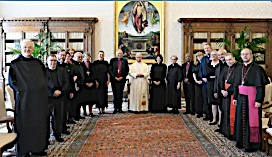
Pope Leo’s address to the Lutheran World Federation
Thursday, 1 October 2026
“The grace of our Lord Jesus Christ, the love of God,
and the communion of the Holy Spirit be with you“
(2 Cor 13:13).
My dear brothers and sisters in Christ,
I warmly welcome the representatives of the Lutheran World Federation.
I would like to extend a special greeting to the president of the Federation.
Thank you for your kind words and for your beautiful gift.
I also greet the General Secretary, Reverend Burghardt, who is present.
I would like to renew my gratitude for your presence at my inauguration last year.
I am pleased that the Lutheran-Catholic relations have matured both spiritually and theologically over the decades.
The international dialogue, now in its sixth phase, has provided valuable insights.
A significant milestone in our ecumenical journey was the Joint Declaration on the Doctrine of Justification.
However, the texts developed in previous years, particularly The Eucharist, The Ministry in the Church, and Ways to Community, deserve to be revisited and embraced more deeply.
Five years ago, during a private audience with the Lutheran World Federation, my predecessor, Pope Francis, delivered a beautiful address describing the significance of ecumenism. “Ecumenism is not an exercise of ecclesial diplomacy but a journey of grace.
It depends on the grace of God, which purifies memories and hearts, overcomes attitudes of inflexibility and directs towards renewed communion”
The goal of our ecumenical journey of grace is renewed communion in the apostolic faith, the sacraments, and the ministries.
We walk this journey together, guided by the Gospel.
On our shared path from conflict to communion, there are significant moments.
As you mentioned, the year 2030, the 500th anniversary of the Augsburg Confession, could be one such moment.
It could be a profound ecumenical experience that gives us new energy and joy as we move towards full, visible unity.
On June 25, 1530, when the Confessio Augustana was read in Augsburg, the unity of the Western Church was in jeopardy but not yet destroyed.
The authors of the Augsburg Confession intended to bear witness to their faith in the one, holy, catholic, and apostolic Church.
It was originally intended as a document of reconciliation within the Church.
It was only later that it came to be understood as a text of divisive confessionalization.
As we look forward to 2030, it would be good if we could once again affirming together the pre-confessional ecumenical potential of the Confessio Augustana.
I earnestly appeal to all believers, and especially theologians, to focus on Christ and his gospel.
Let us return, with deep devotion, to our common roots and the faith of the early Church and the Church Fathers.
In doing so, we will rediscover the apostolic and pre-confessional heritage that truly unites us as brothers and sisters in Christ.
Christ must not become a “foreign word” in our world.
Our world needs ecumenical witnesses of Christ who reveal him through their lives and actions.
Christ alone is the living source capable of fulfilling humanity’s deepest longings.
Dear brothers and sisters, united in this shared ecumenical and missionary task, I would like to thank you once again for your visit.
Let us renew our commitment to unity by praying together now as the Lord has taught us.
The Lord’s Prayer (recited together).


