 0
0
 0
0
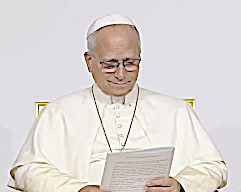
Pope Leo’s meeting with members of The Provincial Synodal Assembly,
Catechumens and Newly Baptized
Institut Catholique de Paris (Catholic Institute of Paris) – Saturday, 26 September 2026
“I am struck by the number of people returning to the faith“ (Pope Leo)
Pope Leo’s Address
Dear priests and consecrated persons,
Dear members of the Synodal Assembly,
Dear catechumens and newly baptized, brothers and sisters,
Today, we are hosted by the Institut Catholique de Paris, an institution situated at the intersection of science and faith that has helped to educate minds and hearts in the service of the Gospel for centuries.
I would like to greet the faculty, students and staff of this university, as well as all the members of this Provincial Assembly who are involved in reflecting on the pastoral initiatives for welcoming the newly baptized and catechumens, and on the life of the Church.
Having observed your work closely — I am first and foremost filled with deep gratitude for God’s unfathomable work.
Like you, and together with you, I am struck by the number of people returning to the threshold of the faith, and by the many adults seeking the Christian initiation sacraments.
It may seem paradoxical that so many people are rediscovering the Gospel and embracing the faith against the backdrop of a deeply secularized society like France’s. Your experiences and testimonies, dear catechumens and newly baptized, are a tangible sign of God’s grace, which surpasses any statistical or sociological analysis.
This phenomenon contradicts defeatist attitudes and what Pope Francis calls “sterile pessimism” (Apostolic Exhortation Evangelii Gaudium, 84–86) and must be welcomed with responsibility.
We are called to reach out to our brothers and sisters and rediscover God’s way of acting, characterized by closeness, compassion, and tenderness.
With pastoral tenderness and fraternal charity, we must recognize, welcome and protect the small flame that the Holy Spirit has kindled in the darkness of the night and the tiny seed that strives to grow even amid the thorns.
As we marvel at the changes taking place in the lives of our brothers and sisters, we must avoid becoming complacent or overly optimistic.
On the contrary, we must remain committed and open to searching, asking ourselves questions, and implementing concrete pastoral initiatives.
The Holy Spirit inspires your Synodal Assembly and, more broadly, the life of the Church in France.
Filled with wonder at God’s surprising work, we must ask ourselves: What must we do, and where is the Spirit leading us in our efforts to accompany catechumens, the newly baptized, and those “beginning anew”?
First, I would like to recall an expression used by the French episcopate a few years ago and urge you to envision and embody a church in a “state of initiation” — one that supports catechumens, the newly baptized, and those returning to the faith by offering them solid and steadfast guidance over time.
Christian initiation has indeed been at the center of pastoral efforts since the years following World War II.
Even then, there were numerous proposals, and the theological and liturgical developments of those years contributed greatly to the renewal of catechumenate programs during the Second Vatican Council.
Although today’s circumstances are different, you can draw upon this deeply rooted pastoral tradition of accompanying catechumens.
Furthermore, we should not forget that the existing practice was further strengthened in 1996 when both the Letter to the Catholics of France and the latest French edition of the Rite of Christian Initiation of Adults were published.
Dear brothers and sisters,
Being “in the process of initiation” means welcoming those who are newly seeking God and recognizing an opportunity and a mission in them.
Thanks to them, the community of believers can renew its journey of faith and experience the joy of the Gospel in a new way.
However, the mission consists of nurturing and guiding them, even after they have received the sacraments.
We must joyfully welcome those who come to us, build on their spiritual experiences, respect their personal histories, and foster the essential proclamation of the kerygma, drawing upon the forms with which they are familiar from their personal or communal journeys.
Moreover, let us not forget that many of these people will later ask the same question we heard in Marielle’s testimony.
How can one avoid post-baptismal emptiness?
Therefore, it is necessary to fully integrate these people into our communities and prayer gatherings after baptism.
We must offer them a welcoming environment and comprehensive formation that embraces the various aspects of Christian life and fosters harmony between faith and life.
As newly baptized individuals, they must deepen their understanding of the foundations of the Christian faith, receive adequate training in biblical and theological matters, and discover the richness of doctrine and the various dimensions of Christian moral action corresponding to their profession of faith.
Finally, they need to be initiated and introduced into the liturgical life of the Church.
As we heard in the testimonies, for some, celebrating liturgical rites has been a way to enter into the mystery of the faith.
This is a fundamental aspect of the life of the Church and requires pastoral care grounded in the teachings of the Second Vatican Council.
The liturgy cannot be considered something that comes “after” catechesis, where one merely applies what has been learned.
Rather, the liturgy manifests and makes present Christ’s Paschal Mystery. It is an event capable of revealing the meaning of the Good News and the life of God.
Through its rhythms, languages, and rites, the liturgy is part of the journey of conversion and preparation for the sacraments.
The role of formators is fundamental to carrying out this mission.
As the ancient tradition of the Church teaches us, godfathers and godmothers—representatives of the community—must be prepared and specially trained to initiate the newly baptized.
As part of this training, I recommend developing a thorough understanding of the Rite of Christian Initiation of Adults.
At the same time, pastoral workers must be trained in not only the Bible, theology, liturgy, and spiritual life, but also human qualities. This will enable them to guide and accompany individuals with more complex and less straightforward life journeys.
Some people come with a simple spiritual thirst, a search for meaning, and an attraction to the Gospel. Others arrive burdened by painful experiences, loneliness, and profound difficulties.
This is where a style of closeness, compassion, and tenderness takes on its full meaning. We must strike a wise balance to welcome, listen to, and encourage them to face the challenging demands of the faith.
It is a journey in which we must respect each person’s pace, proceeding gradually and carefully with fraternal accompaniment.
This means adopting the style of “walking together.”
Along the pathways of the Christian faith, we enrich one another. We grow together as priests, laypeople, godparents, catechumens, pastoral leaders, and the newly baptized.
I am reminded of what happened to St. Augustine, one of the most famous catechumens in history.
St. Ambrose introduced him to the faith, and his faith was like a tiny seed when he was baptized.
Yet that seed grew and multiplied, becoming a tree so large that, even today, we can find shelter beneath its branches.
Looking at you, dear catechumens and newly baptized individuals, I see the fruits of the Holy Spirit who guided you on this path.
I also see the promise of your future contributions to the Church in France.
Be missionaries of the Gospel in this society
May the great saints of this beloved land sustain you on your journey.
I think of St. Thérèse of the Child Jesus, whose “little way” teaches us that trust opens the doors to grace, and of St. Martin of Tours, an emblematic figure of sharing and fraternal charity.
Along with the many other saints from France, they remind us that our mission is built by remaining faithful to the Lord’s presence in our daily lives.
By welcoming one another, together may you form the living people of the Church in
France is capable of passing on the faith.
I invoke the maternal protection of the Virgin Mary, the principal patroness of France, and the intercession of Saints Genevieve and Denis, the protectors of this city.
I cordially impart my blessing upon all of you.
Thank you, and may your journey be blessed!


