 0
0
 0
0
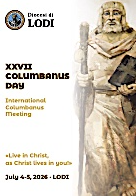
Pope Leo’s letter to the Bishop of Lodi, Italy
on the occasion of the 37th Columbanus Day
signed by the Cardinal Secretary of State, Pietro Parolin,
(Lodi, Italy: July 4-5, 2026)
Pope Leo’s Letter,
Your Excellency,
This twenty-seventh edition returns to Lodi, where it began.
First of all, I would like to congratulate you on your perseverance in carrying out this initiative over the years.
It has involved more and more ecclesial and civil communities named after St. Columbanus in Europe, promoting knowledge of the great abbot, his spiritual heritage, and his relevance to European culture. (See Footnote The Life of St. Columbanus below)
In particular, I appreciate the fact that, in the name of St. Columbanus, we have learned not to keep God’s gifts for ourselves, but to share them with everyone.
The Columban Days have brought together people of different languages and nations, inviting them to rediscover the values of the Christian tradition together and respond to the challenges of our time.
One of the most important challenges is that of peace.
In this regard, I invite us to learn from St. Columbanus an indispensable attitude for any reconciliation journey: the penitential attitude.
With this attitude, one humbly acknowledges one’s faults, both personal and collective, before God.
When a conflict degenerates into war with tragic consequences of death and destruction, we must implore God’s mercy instead of accusing each other.
Only divine mercy can instill human mercy in hearts and cause enemies to reach out to each other.
Inspired by the luminous figure of the Holy Abbot, I wish everyone a happy Columbanus Day in Lodi.
I recently went there to pay homage to St. Frances Xavier Cabrini.
I cordially send my apostolic blessing to all who will take part.
Footnote: The Life of St. Columbanus
Born into a wealthy family, he received an education at home from private tutors.
His education followed the typical rules of family rank.
Everything was normal until, around the age of fifteen.
He went to a reclusive woman with a reputation for holiness to ask her what to do with his life.
She showed him the way to the monastery, recognizing his solid spirituality.
After returning home and giving the matter much thought, he made the firm decision to leave home and his standard of living behind to join the monastery of Clain-Inis, led by Abbot Sinell.
The choice of the monastery
He dedicated himself to prayer and the study of Scripture and the Fathers of the Church, becoming fascinated by his discoveries.
However, a shortage of time made him realize that he needed to leave because his family and friends were disturbing him with their frequent visits.
He moved north to the Monastery of Bangor, guided by Abbot Comgallo’s austere rule.
He found his place there and was soon referred to as the Master of Novices.
However, he ultimately left to become a missionary in Central Europe, where faith was once again giving way to paganism.
The monastery of Luxeuil
He left with twelve monks and headed for Gaul, landing in 588.
After receiving permission from the King of Burgundy, he founded a monastery near Annegray in an ancient, ruined Roman fortress inside a forest.
This location guaranteed peace and tranquility while providing a good starting point for evangelizing and welcoming those who had become aware of the new monastery.
The arrival of new monks led to the construction of two more monasteries: one in Luxeuil and the other in Fontaine.
The founding Abbot
Jonah of Bobbio was a monk who entered the monastery three years after the abbot’s death.
He was also the secretary to the first two abbots who succeeded him.
Jonah was commissioned to write the saint’s biography.
He brings us back, between legend and history, to some traits of the founding abbot.
Jonah reports, “One day, Columbanus had to write the Rule for the monks of the three monasteries. He retired to a cave. In the evening, however, the bear returned with its prey. The two looked at each other carefully.
The bear watched Columbanus, ate its prey, and left, leaving the abbot alone to rest.
This shows how the holy abbot had become one with nature.
He wrote the Rule for Monks and the Domestic Rule.
Some details reveal the strict life in the monastery: six strokes of the rod for saying “mine” or “yours” about an object and thirty strokes for not answering “Amen” in chorus. It was certainly a demanding rule.
Queen Brunechilde’s wickedness
The Queen, mother of King Theodoric, did not allow her son to marry because she wanted to keep the power for herself.
However, she allowed her son to have as many women as he wanted.
The people could no longer stand the Queen Mother, but no one knew how to deal with her.
Even the bishop of Vienna did not know how to resolve the matter.
Impatient, he went to ask Columbanus for advice.
He took the king’s two illegitimate sons with him and asked the abbot to bless them.
In this way, the bishop hoped to legitimize a situation that had become unsustainable.
However, Columbanus opposed it, and the Queen Mother decreed that no one could enter or leave the monastery.
The king tried to ensure his children could receive the blessing by bringing abundant gifts.
He entered the refectory, thus violating the cloister.
Driven out by the monks, Queen Brunechilde banished Columbanus and his monks from her kingdom.
Bregenz
Given the situation, Columbanus left the land and embarked on a journey to Rome.
However, upon the death of the king and queen mother, his successor asked Columbanus to turn back, but he refused.
Upon arriving in Bregenz, a priest offered the monks a church near Lake Constance, which they renovated and used as a kiosk.
Bregenz gradually became a second Luxeuil.
Columbanus still desired to reach Rome.
He left Gallus, one of the twelve monks who had left with him for Bregenz.
Gallus carried out an intense evangelization campaign in the area, which took his name: St. Gall.
Meanwhile, he arrived in Bobbio, 30 kilometers from Piacenza, where he was welcomed and built his most impressive monastery.
The most important library in Italy is located here.
Columbanus died on November 23, 615.
His relics are kept in the crypt of the basilica that was built in his honor.
He is the patron saint of the diocese and the city of Piacenza.
Cardinal Schuster writes of him:
“In the Middle Ages, Columbanus was the popular miracle worker saint to whom the faithful turned to obtain even temporal favors.
He remains the greatest man of his time for his gifts of culture and gifts of grace; like St. Bernard, this hermit has a European personality: he makes despots tremble, he makes God fear and love… its rule is rigid: after all, it is the Gospel adapted to the men of the sixth century.”


