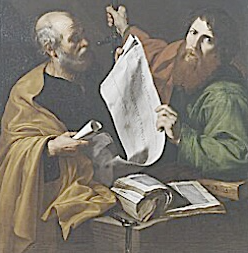
Illustration; Peter and Paul by Jusepe de Ribera (1591–1652)
Pope Leo’s homily on the solemnity of Saints Peter and Paul
St Peter’s Basilica – Monday, 29 June 2026
Dear brothers and sisters,
Today, in a single Solemnity, we commemorate the Solemnity of Ss. Peter and Paul.
Peter and Paul are the patron saints of Rome and its diocese.
Jesus chose Peter as the shepherd of his flock and Paul as the apostle to the Gentiles.
We venerate them as two pillars of the Church.
Peter, the guardian of the people of God, is often portrayed in the New Testament as striving to maintain unity among his brothers.
After a night of seemingly fruitless labor on the Sea of Galilee, he told the Master, “We caught nothing. But on your word, I will let down the net” (Luke 5:5).
He then sets sail, taking the others with him.
Again, when many turn away from the Lord after the difficult discourse on the Bread of Life, Peter said to the Messiah, “To whom can we go? You have the words of eternal life,” and he remained with the other eleven disciples.
At Caesarea, he recognizes Jesus as the Son of God.
As we heard in the Gospel (Matthew 16:13–19), he spoke for all in professing the one faith. Even after the resurrection, Peter was the first to reach Christ on the shore of the lake. He jumped into the water and swam ahead of the others to humbly renew his love and receive confirmation of his mission. (John 21:1-17).
Peter remained faithful to his mission, even when the question of admitting uncircumcised Gentiles to baptism threatened to divide the community in Jerusalem.
He gathered the brothers, listened to them, and, guided by the Holy Spirit, ultimately made a decision that preserved unity and ushered in a new era for all the people of God.
Indeed, he declared, “We believe that we will be saved through the grace of the Lord Jesus, just as they will” (Acts 15:11).
Peter’s magnanimity does not mean he is perfect.
During the Passion, he denied the Master, only to later shed sincere tears of repentance (Luke 22:54–62).
Paul rebuked him for the inconsistency of his actions in different circumstances (Galatians 2:11–14).
Yet Peter acknowledged his mistakes and repented without becoming discouraged or failing in his mission to proclaim the Gospel and gather Christ’s flock, even unto martyrdom—a fate he suffered here in Rome, not far from where we gather today.
The symbol of the keys, with which we often identify Peter (faithfully and patiently expresses this concern for unity. (Matthew 16:19).
A key doesn’t break down doors; it opens and closes them by finding the proper levers and guiding their movement so that locks release, bolts withdraw, and doors turn freely on their hinges.
This joins rooms together, transforming many isolated spaces into one welcoming home.
Similarly, unity within the Church is not achieved by rigidly clinging to one’s own position, but by seeking points of encounter in the truth in the hearts of others.
In this light, each person becomes a means of growth for another.
In this light, we can understand the mission that the Lord entrusted to Peter and his successors for the benefit of the entire Holy People of God.
With his help, it is a mission to listen to the voice of each person, discern inspirations, guide the way, correct errors, and instruct, encourage, exhort, and accompany our brothers and sisters.
In this way, they may cooperate in the salvation of one another and of all humanity, docile to the action of the same Spirit (1 Corinthians 12:1–11).
Peter’s example invites every Christian to become a builder of unity by placing God at the center of one’s life, drawing close to one’s brothers and sisters, and being attentive to their circumstances and needs.
In this way, we learn to live with one another in charity so that the message may be fully proclaimed. (2 Timothy 4:17).
Paul, the other great apostle we celebrate today, was also a tireless herald of the Good News.
He, too, has distinctive symbols: the book and the sword, which are closely linked.
The author of the Letter to the Hebrews explains this well when writing that “the word of God is living and active, sharper than any two-edged sword,” capable of penetrating “until it divides soul from spirit” and discerning “the thoughts and intentions of the heart.” (Hebrew 4:12).
God accomplished this in the heart of the young Saul, winning him over (Phil. 3:12).
First, God brought Saul to conversion to the Gospel and gave him a new name.
Then, God sent him to proclaim the Gospel throughout the world.
Like Peter, Saul was destined to bear witness to the Gospel, even giving his life in this very city.
The Apostle Paul allowed himself to be transformed by the power of God’s Word.
It rescued him from a life of violence and led him onto a path of love.
St. Augustine, commenting on Paul’s conversion and mission, said, “As he was traveling [to Damascus] with a heart filled with threats and murder, he was called by name and thrown to the ground by the heavenly voice (Acts 9:1–7), that is, by the Word who was calling him”.
And he added: “God took the persecutor of the Church and made him a messenger of peace.
He forgave him all his sins and placed him in a ministry where he could forgive the sins of others”.
Dear friends,
Today, it is important for us to look to Ss. Peter and Paul to understand how we can be apostles, builders of unity, and generous servants of truth and charity.
In this spirit, we are about to celebrate the ancient and moving rite of conferring pallia on Metropolitan Archbishops.
These white wool bands adorned with crosses express the commitment of every shepherd—and every Christian—to take the brothers and sisters entrusted to them upon their shoulders like lambs of the Lord’s flock.
They sacrifice their energy, time, and effort, and even their lives, for them.
They do so, to ensure that the Gospel may reach everyone and so that the whole world may find harmony and concord in it.