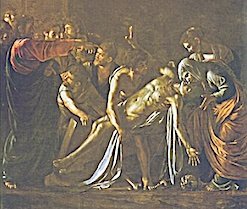
The raising of Lazarus by Caravaggio
Pope Leo’s address to Dicastery for the Service of Integral Human Development
in Clementine Hall – Thursday, November 26, 2026
Scripture Reading John 11:38-44
Jesus Raises Lazarus to Life
38 Then Jesus, deeply moved again, came to the tomb; it was a cave, and a stone lay upon it. 39 Jesus said, “Remove the stone.” Martha, the sister of the dead man, said to him, “Lord, by this time there will be an odor, for he has been dead four days.” 40 Jesus said to her, “Did I not tell you that if you would believe you would see the glory of God?” 41 So they took away the stone. And Jesus lifted up his eyes and said, “Father, I thank thee that you have heard me. 42 I knew that you hear me always, but I have said this on account of the people standing by, that they may believe that you sent me.” 43 When he had said this, he cried with a loud voice, “Lazarus, come out.” 44 The dead man came out, his hands and feet bound with bandages, and his face wrapped with a cloth. Jesus said to them, “Unbind him, and let him go.”
Pope Leo’s address
In the name of the Father, the Son, and the Holy Spirit.
Peace be with you.
Good morning to you all, and welcome!
I extend a greeting to Sister Alessandra Smerilli, the other superiors, officials, and all the members of the Dicastery for Promoting Integral Human Development.
I greet those who are continuing their term of office and to those beginning theirs, coming from so many countries and with different ministries, areas of expertise and sensibilities.
The apostolic constitution Praedicate Evangelium (Preach the Gospel) entrusts you with a demanding task: namely, to co-operate with the Successor of Peter and through the bishops, with the local Churches, for integral human promotion, manifesting Christ’s love for the poor, the dispossessed and the excluded, and towards all those who, due to injustice, illness, disability or the consequences of environmental disasters, find their full development limited or hindered (cf. Art. 163).
The plenary session responds to this mandate in a particular way; it is an intense time of synodality, in which the voices of those who have no voice, or whose cry is lost in the noise of the media, are also heard. You are a two-way bridge: to receive and discern, to reflect upon and communicate.
The reflection I wish to share with you relates to the very heart of your service:
the inseparable link between evangelization and the social dimension of faith.
I know that you are ever mindful of the twofold risk: on the one hand, of reducing the Gospel to a mere social or welfare program, thereby emptying it of the transcendent newness of the Kingdom of God; and on the other, of separating the proclamation from the concrete lives of individuals and peoples.
The Magisterium has always rejected both these tendencies, which betray the logic of the Incarnation, the heart of Revelation.
The Gospel is not a social program, nor is it an experience lived outside of history.
In Christ there are not two missions, one spiritual and one social.
There is a single mission, the messianic one: He is the Saviour of every human being and of the whole person.
As I emphasized in Dilexi te and Magnifica humanitas, integral human development is inseparable from evangelization.
It is the historic form that the Gospel takes when it reaches the lives of people and communities.
Those who proclaim Christ cannot remain indifferent to what harms human dignity. Those who serve the dignity of their brothers and sisters encounter the face of Christ in them.
Dear friends,
The Social Doctrine of the Church is a living tradition, that reinterprets the Gospel in light of the signs of the times and allows itself to be challenged by changing contexts.
It stems from listening to God, who is silently at work in human affairs, and from listening to the People of God, especially the poor.
It is developed through the discernment of Christian communities which, in communion with their Pastors, interpret their situation in the light of the Gospel.
The Dicastery for the Service of Integral Human Development is one of the places where the Magisterium takes shape.
It gathers the experience of local churches, it offers it to the Successor of Peter, and then returns it, enriched, to the entire Church.
This dynamism does not seek to impose solutions from above: rather, it serves development by accompanying individuals and communities, so that, under the guidance of the Holy Spirit, they may be the agents of their own journey.
An icon of this service can be found in the Gospel according to John, in the account of the resurrection of Lazarus.
Standing before the tomb, the Lord twice asks those present for their help.
First, he says, “Remove the stone!” (John 11:39).
Then, when Lazarus emerges still bound, Jesus commands them, “Unbind him and let him go” (John 11:44).
Between these two actions lies what only Jesus can do: call His friend back to life.
We are entrusted with what comes before and what comes after.
First, removing the stones that block the way.
Afterwards, untying what still binds the one who has come back to life.
Removing obstacles and liberating the energies of goodness.
The first guiding principle of the mission, therefore, is the commitment to remove the obstacles that hinder the growth of God’s children and the contexts in which they find themselves.
Removing obstacles means denouncing, with evangelical parrhesia, the structures of sin that create misery, harm our common home and seek to reduce the person to an economic cog.
Pope Francis, in the Encyclicals Laudato si’ and Fratelli Tutti, offered a wealth of teaching in this regard, pointing to integral ecology and universal fraternity as the true alternative to the dominant technocratic paradigm.
In Magnifica Humanitas, I relaunched an appeal to build the civilization of love by rejecting the culture of power, fueled by the logic of algorithmic efficiency and profit, which discards the most vulnerable members of humanity.
The second principle of the mission consists of liberating the energies of goodness.
It calls for the boldness to loosen the knots that prevent the resources and charisms already sown by the Holy Spirit from manifesting themselves and growing.
The Church is sent into the world to set free, through the proclamation of the Gospel, the forces of goodness that already dwell within it, so that every Christian community may renew society from within and promote peace.
To act in this way means being willing to assist the work of the Spirit, welcoming the Kingdom of God, and following the Risen Jesus Christ wherever He leads us.
As you know, I have placed peace at the heart of my Petrine ministry from the very beginning.
The Dicastery for the Service of Integral Human Development has a particular role to play in this service, working in constant collaboration with the local Churches.
Together we can show, in the faces, the voices and the stories of so many of our brothers and sisters, that peace is not merely the absence of war or the political balance of power. Peace is the fruit of commitment to justice, respect and care for human dignity, the patient construction of fraternity among peoples, and the promotion of an integral ecology.
The challenges of our time are interconnected.
For this reason, your work requires patience, a broad perspective and the collaboration of many minds and many hands.
Dear friends, I urge you to renew your commitment to the spirit and method of the Second Vatican Council, which sought to interpret the most urgent problems of the contemporary world “in the light of the Gospel and of human experience”
(Pastoral Constitution Gaudium et Spes, 46).
You are called upon to be witnesses to this, in the local Churches, in institutional settings and in public debate.
Service to integral human development is certainly one of the priority paths through which the Gospel message is proclaimed.
I accompany you with my prayers.
I wish you every success in these days, which will conclude at the threshold of Advent, the quintessential season of waiting.
May you be, in the Church and in the world, servants of a hope that knows how to wait patiently and act courageously.
I cordially bless you and your communities.
Thank you.