 0
0
 0
0
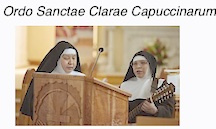
Pope Leo’s address to the Capuchin Poor Clare Nuns of Italy
Consistory Hall – Monday, 21 September 2026
In the name of the Father and of the Son and of the Holy Spirit.
Peace be with you! One can also say “peace and goodness”!
Dear sisters, brothers, good morning and welcome everyone!
I am very happy to meet you and to share this moment of reflection.
Today, we will take our cue from the liturgy of the Feast of St. Matthew.
In the Letter to the Ephesians, Saint Paul exhorts, “Conduct yourselves worthy of the call you have received, with all humility, gentleness, and patience… There is one hope to which you have been called, that of your calling” (Ephesians 4:1-2, 4).
It is an invitation to fidelity, to which your Federation responds through the charisms of St. Clare and St. Francis: contemplative prayer, poverty, and total adherence to the Gospel.
The work of reworking and updating the Constitutions, in which the contributions of many were synthesized, is praiseworthy.
The Constitutions reaffirm that “the first and principal task of all religious is the contemplation of divine realities and constant union with God in prayer”
(Constitutions 60; cf. CIC can. 663).
As St. Clare wrote to St. Agnes of Bohemia:
“Place your mind in the mirror of eternity, your soul in the splendor of glory,
and your heart in the image of divine substance.
Through contemplation, transform yourself into the image of His divinity.”
(Third Letter to Blessed Agnes of Bohemia, 12-13; FF 2888).
And it is with the “mind in the mirror of eternity” that I invite you to reflect on the present time, with with its dramas and uncertainties, as well as the challenges of your “little world“, which is rich in history and is called to look to the future with hope.
The small number of vocations, in particular, could lead some to consider closure or retreat.
However, I want to reiterate what I said about the future of dioceses and seminaries in Italy.
Let us try to change our perspective when considering this reality.
Its critical issues can help us discover or rediscover unexpected potential, “not so much with regard to numerical strength, but to the quality of the proposal”
(Address to the Pilgrims of the Tuscan Dioceses, 11 October 2025).
Today’s Gospel reminds us of this: “It is not the healthy who need a doctor, but the sick” (Matthew 9:12).
The reduction in the number of communities – and the resulting fear of losing autonomy – must not distroy and take away hope but rather inspire a renewal of one’s own life and an increased commitment to spiritually accompany those who knock on the monasteries doors.
This will foster the growth of joyful, living communities in which to experience intimacy with God, affability, communion, and authentic relationships.
Vocations are not born from organizational strategies or campaigns planned at a desk, but from prayer, familiarity with the Gospel, silence, and knowing how to accept oneself with one’s imperfections from feeling part of a whole that creates unity.
(Galatians 6:2 – Bear one another’s burdens, and so fulfil the law of Christ),
To do this, the Lord does not ask us to be perfect.
Rather, he asks us to allow his grace to shape us humbly day by day.
To do this, the Lord does not ask us to be perfect, but rather to allow his grace to shape us humbly day by day.
This is also the specific missionary nature of the cloistered vocation.
Psalm 18, also taken from today’s liturgy, says: “Without language, without words, without their voice being heard, their message is spread throughout the whole earth, and their message to the ends of the earth” (Psalm 18:4-5).
The Lord calls you, formed in the school of the Gospel, to be his witnesses in silence and contemplation.
You will place yourselves in history as a living and prophetic memory of the Good News.
As sisters of St Clare, then, you have a special message to proclaim.
This message is first conveyed through your observance of the Rule and your Constitutions.
Your mission is to live the Gospel by leaving all that is of the world behind and directing yourself totally and constantly to the first and only Love of your life.
This implies sobriety, detachment from material possessions, self-surrender through obedience, and transparency.
“Your choice of a life of stability becomes an eloquent sign of fidelity for our globalized world, accustomed to increasingly rapid and easy relocations, with the risk that many persons never sink roots in any one place”. (Francis, Apostolic Constitution n. Vultum Dei quærere, 35).
For this reason, dear friends, I would like to conclude by addressing a question from your Federal Assistant: “Can cloistered women’s monasteries offer answers to today’s questions about the meaning of humanity?”
He indicated four means that I consider important to answer this question:
– mutual listening,
– koinonia (a communion of intentions to avoid isolation),
– diaconia (serving and working together), and
– martyria (bearing witness to the Gospel).
I leave these with you as safe paths for your journey.
Dear Sisters, I thank you for what you do and for what you are: “torches, sentinels for the Church and for the world,” – signs of the presence of the Kingdom of God on earth.
(Francis, Message to Contemplatives, 21 November 2018),
I am pleased to have met you.
Invoking the intercession of Mary, of Saints Francis and Clare of Assisi and of Blessed Maria Lorenza Longo, I cordially impart my Apostolic Blessing to you.


