 0
0
 0
0
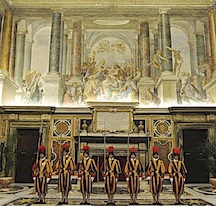
Media: Clementine Hall with Swiss Guards
Pope Leo’s greeting to participants of the 8th colloquium between
the Dicastery for Interreligious Dialogue and the Royal Institute for Inter-Faith Studies
Clementine Hall – Monday, 11 May 2026
The Royal Institute for Inter-Faith Studies was established in 1994 in Amman, Jordan,
under the patronage of His Royal Highness Prince El Hassan bin Talal.
Peace be with you.
Your Royal Highness Prince Hasan bin Talal,
Dear brothers and sisters,
It is a pleasure to welcome you all to this eighth colloquium, which is being held jointly by the Dicastery for Interreligious Dialogue and the Royal Institute for Inter-Faith Studies.
The theme you have chosen this year, ‘Human Compassion and Empathy in Modern Times’, could not be more relevant to our world today.
These are not marginal sentiments, but essential attitudes in both our religious traditions, and important aspects of what it means to live a truly human life.
In the Muslim tradition, compassion (rafa) is associated with mercy, which is considered a gift bestowed by God upon believers. One of the divine names, al-Ra’uf, reminds us that compassion always originates from God Himself.
Similarly, the Christian tradition teaches that God is not indifferent to suffering. In the Book of Exodus, for example, God tells Moses, “I have seen the misery of my people… I have heard their cry”.
In Jesus Christ, this divine compassion becomes visible and tangible.
God goes beyond merely seeing and hearing by taking on human nature and becoming the living embodiment of compassion.
Following Jesus’ example, Christian compassion involves sharing in, or ‘suffering with’, the experiences of others, particularly the most disadvantaged.
For this reason, “love for the poor — whatever form their poverty may take — is the evangelical hallmark of a Church faithful to the heart of God” (Dilexi Te, 103).
In our tradition, human compassion and empathy are not optional extras, but a divine call to reflect God’s goodness in our daily lives.
This belief, therefore, has social implications.
Pope Leo XIII taught that the poor and marginalized deserve special consideration and assistance from society and the state (Rerum Novarum, 37).
In this regard, I would like to express my gratitude for the Hashemite Kingdom of Jordan’s generous efforts in welcoming refugees and assisting those in need in difficult circumstances.
Dear friends,
Compassion and empathy are sadly in danger of disappearing today.
Technological advances have made us more connected than ever before, but they can also lead to indifference.
The constant stream of images and videos showing others experiencing hardship can desensitise us rather than move us.
Pope Francis warned in his homily in Lampedusa on 8 July 2013, “we have become accustomed to the suffering of others, thinking: it does not affect me. It does not interest me. It is none of my business”.
This type of apathy has become one of the most serious spiritual challenges of our time.
In such a context, Christians and Muslims are called to a common mission drawing from the richness of our respective traditions: to revive humanity where it has grown cold, to give voice to those who suffer and to transform indifference into solidarity.
Compassion and empathy can be our instruments as they have the power to restore the dignity of others.
It is my hope that Jordan will continue to be a living witness to this kind of compassion, as well as a sign of dialogue, solidarity and hope, in a region that is marked by trials.
May our collaboration bear fruit in the form of concrete gestures of peace, empathy and fraternity.
Thank you!
As it is in our tradition to seek peace as one of God’s most important blessings, I ask for God’s blessing upon all of you.
May the Lord be with you.
May the blessings of the almighty Father, Son and Holy Spirit come down upon you and remain with you always. Amen.