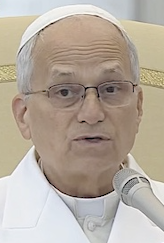
Pope Leo’s speech to the International Theological Commission
Consistory Hall – Wednesday, November 25, 2026
Scripture reading: Mark 4:26-32
Jesus said, “The kingdom of God is as if a man should scatter seed upon the ground, and should sleep and rise night and day, and the seed should sprout and grow, he knows not how.
The earth produces of itself, first the blade, then the ear, then the full grain in the ear.
But when the grain is ripe, at once he puts in the sickle, because the harvest has come.”
And he said, “With what can we compare the kingdom of God, or what parable shall we use for it?
It is like a grain of mustard seed, which, when sown upon the ground, is the smallest of all the seeds on earth; yet when it is sown it grows up and becomes the greatest of all shrubs, and puts forth large branches, so that the birds of the air can make nests in its shade.”
Pope Leo’s speech
In the name of the Father, the Son, and the Holy Spirit.
Peace be with you.
Eminence, Excellencies, brothers and sisters,
I am delighted to meet with the recently renewed International Theological Commission on the occasion of its eleventh five-year anniversary and first plenary assembly.
I am grateful for its significant contribution to the Church’s mission, as it continues to exercise understanding of the faith along the path traced by the Second Vatican Council’s magisterium. In the light of the Gospel, it discerns new challenges and opportunities arising from different cultural contexts.
Thank you for your availability and generosity in accepting this task, and for your work in recent days and in the years to come.
In light of the events our time is experiencing and the problems we are called to address,
“we do not interpret the present as a closed destiny, but as an open field for personal and collective conversion. And we believe in the strength of the Kingdom, which develops from the smallness of a mustard seed that, once sown, sprouts and grows (Encyclical Letter Magnifica humanitas, 210).
The mission of the Church, in all its expressions and in every circumstance, is indeed placed at the service of the Kingdom of God, of which it constitutes on earth the seed and the beginning”.
It is from this perspective that, with crucial relevance, the deepening of the two themes that are the subject of your reflection takes place: Apostolic Tradition and the cultural forms of transmission of faith.
The first theme is that of Apostolic Tradition.
It is a reality that refers to the heart of the identity and mission of the Church.
Vatican II teaches that “the Church, in its doctrine, in its life, and in its worship, perpetuates and transmits to all generations all that it itself is, all that it believes” (Dei Verbum, 8).
Inspired by these words, Pope Benedict XVI forcefully affirmed that “Tradition is the permanent presence of the Savior who comes to meet us, redeem us, and sanctify us in the Spirit through the ministry of his Church, to the glory of God the Father” (Catechesis, April 26, 2006).
Yes, to proclaim and bear witness at every time and in every place to the living presence of the Lord Jesus, transmitting it with fidelity and integrity from generation to generation: this is the indispensable good for the Church.
Since holy Tradition is always alive, our knowledge of this reality is subject to coherent and constant deepening.
On the one hand, therefore, a kind of “emancipation, which authorizes detachment, almost a pseudo-liberation, from what […] the Church has taught and professed with authority” must be rejected.
On the other hand, it must be recognized that there is growth in “understanding, both of things and of the words transmitted” (Dogmatic Constitution. Dei Verbum, 8).
This does not imply a break in the teaching of the Magisterium, but rather a development of the principles that animate it: consider, in particular, themes such as war, slavery, the death penalty (see Encyclical Letter Magnifica humanitas, 175).
This dynamism commits the Church to recognize and live its mission as a transmission of the gift of grace it has received from the Father and from which it is continually reborn and takes shape, according to the mandate of his Son Jesus.
It is the Risen One, in fact, who assures the Church of the “immeasurable” gift of the Holy Spirit ( John 3:34 – he whom God has sent utters the words of God, for it is not by measure that he gives the Spirit; John 20:21-22 – Jesus said to them again, “Peace be with you. As the Father has sent me, even so I send you.” And when he had said this, he breathed on them, and said to them, “Receive the Holy Spirit.).
The Tradition that springs from the Holy Trinity is addressed to all humanity, always committing us to fidelity to the “once and for all” (Hebrew 9:12) of the event of Jesus, Christ the Savior.
At the same time, this grace encourages us to listen attentively to what in history “the Spirit says to the Churches” (Revelations 2:7), guiding the People of God in the understanding and practice with which they receive not just a word of men, but what the Word of God truly is (see 1Thessalonians 2:13).
As Saint John Paul II taught, when we confront the new challenges of history we find that “not infrequently the Spirit of God, who ‘blows where he will’ (John 3:8), awakens in the universal human experience, despite its many contradictions, signs of his presence, which help even the disciples of Christ to understand more deeply the message they carry.”
This is how “the Church recognizes that it has not only given but also received from history and the development of humankind” (Apostolic Letter. Novo millennio ineunte, 56).
The Second Theme: the cultural forms of transmission of faith.
This gives rise to the meaning, importance, and relevance of the second theme that will be the subject of your study: the cultural forms of transmitting faith.
Indeed, the inculturation of faith is an indispensable dimension of its coherent transmission from generation to generation.
Saint Paul VI emphasized this: “It is necessary to evangelize […] vitally, deeply, and to the roots the culture and cultures of man” (Apostolic Exhortation. Evangelii nuntiandi, 20);
and Saint John Paul II reiterated it: “A faith that does not become culture is a faith not fully embraced, not entirely conceived, not faithfully lived” (Address to the M.E.I.C. , January 16, 1982).
The transmission of faith is an indispensable process that requires discerning the unique conditions and contexts in which it occurs.
This process invites us to consider the particularities of different peoples, cultural regions, and social situations that characterize our world.
The current historical phase indeed demands a new season of inculturation of faith. Therefore, a reflection on the fundamental theological principles and practical guidelines useful for interpreting, evaluating, and above all promoting forms of proclamation, catechesis, preaching, teaching, and celebration of the faith is more important than ever.
This also implies recognizing that “in popular piety, one can grasp how the received faith has incarnated itself in a culture and continues to be transmitted”
(Francis, Apostolic Exhortation. Evangelii gaudium, 123).
Popular piety shows how the inculturation of the Gospel “makes culture itself become, in turn, a means of transmitting faith.”
Dear brothers and sisters,
Apostolic tradition and inculturation are two valuable aspects of pastoral work that require fidelity, competence, wisdom, creativity, love for the people of God, and trust in the Holy Spirit’s action.
As members of the Theological Commission, you are called to address themes that require you to be theologians capable of reflecting on the living, life-giving truth of Jesus Christ.
This truth can continue to be transmitted throughout history and incarnated in succeeding cultures.
May the Lord accompany you in this task, illuminating the precious service you carry out for the good of the entire Church.
From the bottom of my heart, I bless you and your work. Thank you.