 0
0
 0
0
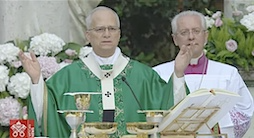
Pope Leo’s homily at Mass for the Care of Creation
Garden of the Madonnina del Borgo Laudato Si’, within the Pontifical Gardens of Castel Gandolfo
Tuesday, 1 September 2026
First Reading: Wisdom 13:1-9
For all men who were ignorant of God were foolish by nature.
They were unable to use the good things they saw to know the One who exists.
Nor did they recognize the Craftsman while paying heed to His works.
Instead, they supposed that fire, wind, swift air, the circle of the stars, turbulent water, or the luminaries of heaven were the gods who rule the world.
If men assumed these things to be gods because of their beauty, let them know how much better than these is their Lord, for the author of beauty created them.
If men were amazed by their power and workings, they should perceive how much more powerful is He who formed them.
For from the greatness and beauty of created things comes a corresponding perception of their Creator.
Yet these men are little to be blamed, for perhaps they go astray while seeking and desiring to find God.
As they live among his works, they keep searching and trust in what they see because the things that are seen are beautiful.
However, they are not to be excused either, for if they had the power to know so much that they could investigate the world, why did they not find the Lord of these things sooner?
Gospel Matthew 6:24–34
“No one can serve two masters, for he will either hate one and love the other or be devoted to one and despise the other.
You cannot serve God and Mammon.”
Therefore, I tell you, do not be anxious about your life, what you will eat or drink, or about your body, what you will wear.
Is not life more than food, and the body more than clothing?
Look at the birds of the air: They neither sow nor reap nor gather into barns, yet your heavenly Father feeds them.
Are you not of more value than they?
And which of you by worrying can add a single hour to your life?
Why are you anxious about clothing?
Consider the lilies of the field and how they grow.
They don’t toil or spin, yet I tell you that not even Solomon in all his glory was dressed like one of these.
If God clothes the grass of the field, which is alive today and thrown into the oven tomorrow, will he not much more clothe you, you of little faith?
Therefore, do not be anxious, saying, ‘What will we eat?’ or ‘What will we drink?’ or ‘What will we wear?’
For the Gentiles seek all these things, and your heavenly Father knows you need them.
But seek first his kingdom and his righteousness, and all these things shall be yours as well.
“Therefore, do not be anxious about tomorrow, for tomorrow will be anxious for itself.
Let the day’s troubles be enough for the day.
Pope Leo’s Homily of Creation
Dear brothers and sisters,
On this World Day of Prayer for the Care of Creation, today’s liturgy offers two readings that invite us to contemplate the works of the Lord. This is certainly not a difficult task in the setting of these beautiful gardens.
The Book of Wisdom (above) encourages us to contemplate the beauty and power of creation, in order to better appreciate its Creator.
It would be superficial to marvel at fire, wind, rushing waters, or the stars in the sky without acknowledging the Creator of these wonders.
Psalm 18 urges us to contemplate the heavens and the firmament, which proclaim the glory of God and declare the work of his hands.
All of creation speaks to us of the greatness of its Creator if we keep our eyes and hearts open to this great mystery.
Similarly, the Gospel passage from Matthew invites us to contemplate creation while emphasizing the Lord’s special love for humanity.
As we marvel at the birds of the air and the lilies of the field, which are precious in the eyes of their Creator, we begin to grasp the extent of God’s love for us.
If the Lord bestows such splendid beauty upon plants and animals and provides for all their needs, how much more attentive will he be to the needs of his beloved children!
This evening, as we accept the invitation to pause and reflect on the works of God, we begin the “Season of Creation”—a five-week period devoted to prayer and commitment to caring for our “common home.”
Therefore, on this day and in the weeks ahead, let us take a few moments to pause from the frenzy of our daily lives and savor the profound harmony of which we are a part.
Let us turn off the many noises generated by human activity so that we may hear the melodious voice of creation through which God, the author of all things, speaks to us.
This task of contemplation, which prepares us to an encounter with the Lord, is the first step towards an “authentic ecological conversion, where the effects of our encounter with Jesus Christ become evident in our relationship with the world around us”
(Message for the Eleventh World Day of Prayer for the Care of Creation, 1 September 2026).
Contemplating creation and encountering its Creator fosters an awareness of our place in God’s plan and our responsibility to preserve the original harmony, both personally and collectively.
As we become aware of our shortcomings and failures, we can renew our commitment to restoring relationships among all creatures according to their Creator’s will.
For this reason, today’s World Day message echoes the prophetic call to “beat swords into plowshares” and transform harm into life.
Isaiah 2:4 – He shall judge between the nations, and shall decide for many peoples; and they shall beat their swords into plowshares, and their spears into pruning hooks; nation shall not lift up sword against nation, neither shall they learn war any more)
It is not too late,
The Season of Creation calls us to a profound conversion:
“What has been used for destruction can be redirected toward life, toward caring for the poor, nourishing the hungry, and safeguarding creation.”
The season begins today and concludes on October 4, the eighth centenary of the ‘Transitus’ of Saint Francis of Assisi.
Pope Francis drew particular inspiration from St. Francis when writing the encyclical letter “Laudato Si’ and establishing the “borough” that welcomes us today.
Let us therefore unite ourselves spiritually with the Poverello of Assisi and make his Canticle of praise our own:
“Praised be you, my Lord, with all your creatures, especially Sir Brother Sun…
Praised be you, my Lord, through Sister Moon and the stars…
Praised be you, my Lord, through Brother Wind…
Praised be you, my Lord, through Sister Water…
Praised be you, my Lord, through Brother Fire…
Praised be you, my Lord, through our Sister Mother Earth, who sustains and governs us.”
Let us renew our commitment with Saint Francis to living and promoting that universal fraternity which is inseparably bound to the task of caring for creation.


