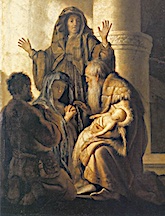
Illustration: Rembrandts Simeon and Anna in the Temple (1627–1628)
Pope Leo’s Homily for Feast of the Presentation of the Lord
30th World Day for Consecrated Life
St Peter’s Basilica – Monday, 2 February 2026
Luke 2:22-40
When the time came for their purification according to the law of Moses, they brought Jesus up to Jerusalem to present him to the Lord(as it is written in the law of the Lord, (“Every male that opens the womb shall be called holy to the Lord”) and to offer a sacrifice according to what is said in the law of the Lord, “a pair of turtledoves, or two young pigeons.” Now there was a man in Jerusalem, whose name was Simeon, and this man was righteous and devout, looking for the consolation of Israel, and the Holy Spirit was upon him. And it had been revealed to him by the Holy Spirit that he should not see death before he had seen the Lord’s Christ. And inspired by the Spirithe came into the temple; and when the parents brought in the child Jesus, to do for him according to the custom of the law, he took him up in his arms and blessed God and said, “Lord, now let your servant depart in peace, according to thy word; for mine eyes have seen thy salvation which thou hast prepared in the presence of all peoples, a light for revelation to the Gentiles, and for glory to thy people Israel.”
And his father and his mother marveled at what was said about him; and Simeon blessed them and said to Mary his mother, “Behold, this child is set for the falland rising of many in Israel, and for a sign of contradicion (and a sword will pierce through your own soul also), that thoughts out of many hearts may be revealed.”
And there was a prophetess, Anna, the daughter of Phanuel, of the tribe of Asher; she was of a great age, having lived with her husband seven years from her virginity, and as a widow till she was eighty-four. She did not depart from the temple, worshiping with fasting and prayer night and day. And coming up at that very hour she gave thanks to God, and spoke of him to all who were looking for the redemption of Jerusalem.
And when they had performed everything according to the law of the Lord, they returned into Galilee, to their own city, Nazareth. And the child grew and became strong, filled with wisdom; and the favor of God was upon him.
Pope Leo’s Homily
Dear brothers and sisters,
On this Feast of the Presentation of the Lord, the Gospel recounts how Simeon and Anna recognized and proclaimed Jesus as the Messiah in the temple.
Before us unfolds a meeting between two movements of love: God’s love, who comes to save his people, and humanity’s, which awaits his coming with vigilant faith.
God presents Jesus as the son of a poor family in the grand setting of Jerusalem to show us that he offers himself to us with full respect for our freedom and shares in our poverty.
His actions are not coercive; they are characterized by the disarming strength of his unarmed generosity.
The expectations of humanity—specifically those of the people of Israel—find full expression in two elderly people: Simeon and Anna.
This moment represents the culmination of a long history of salvation stretching from the Garden of Eden to the Temple courtyards — a history marked by light and shadow, failure and renewal, yet always driven by a single, vital desire: to restore full communion between the Creator and his creatures.
So, just steps from the “Holy of Holies,” the Fountain of Light offers himself as a lamp to the world.
The Infinite gives himself to the finite in such a humble way that it almost passes unnoticed.
Today, on the 30th World Day of Consecrated Life we celebrate with this scene in mind.
We recognize it as an image of the mission of religious men and women in the Church and in the world.
As Pope Francis said, “‘Wake up the world,’ since the distinctive sign of consecrated life is prophecy” (Apostolic Letter to all Consecrated People, November, 21 2014, II, 2).
Dear brothers and sisters,
The Church asks you to be prophets — messengers who announce the presence of the Lord and prepare the way for him.
Borrowing expressions from the prophet Malachi, whom we heard in the first reading, you are invited to become, braziers for the refiner’s fire and vessels for the fuller’s soap through the generous “emptying” of yourselves for the Lord (Malachi 3:1-3 – Behold, I send my messenger to prepare the way before me, and the Lord whom you seek will suddenly come to his temple; the messenger of the covenant in whom you delight, behold, he is coming, says the Lord of hosts. 2 But who can endure the day of his coming, and who can stand when he appears? “For he is like a refiner’s fire and like fullers’ soap; 3 he will sit as a refiner and purifier of silver, and he will purify the sons of Levi and refine them like gold and silver, till they present right offerings to the Lord).
Through this offering, Christ — the one eternal messenger of the covenant, who remains present among humanity today — can melt and purify hearts with his love, grace and mercy.
You are called to this mission above all through the sacrificial offering of your lives, rooted in prayer and in a readiness to be consumed by charity.
Your founders were docile to the action of the Holy Spirit and offer you wonderful models of how to faithfully and effectively fulfill this mandate.
Living in constant tension between earth and heaven, they were guided with faith and courage.
Some were led from the Eucharistic table to the silence of the cloister, while others were led to the demands of the apostolate; some to the classrooms of schools, others to the destitution of the streets or the toil of the missions.
It was this same faith that moved them to humbly and wisely return time and again to the foot of the Cross and the Tabernacle.
There they offered everything and discovered in God both the source and the goal of all their actions.
Through the power of grace, they also undertook perilous missions.
They became a prayerful presence in hostile or indifferent environments, offering a generous hand and a friendly shoulder amid degradation and abandonment. They were witnesses of peace and reconciliation in situations marked by violence and hatred.
They were ready to bear the consequences of going against the current and to become, in Christ, a “sign of contradiction” sometimes even to the point of martyrdom.
Pope Benedict XVI wrote that “the interpretation of Sacred Scripture would be incomplete without listening to those who have truly lived the word of God” (Verbum Domini, 48).
Today, we honor our brothers and sisters who have gone before us as protagonists of this “prophetic tradition, wherein the word of God sets the prophet’s very life at its service” (Verbum Domini, 49).
Above all, we honor them by carrying forward their legacy.
Even today, through your profession of the evangelical counsels and the many charitable works you perform, you are called to bear witness to God’s saving presence in history for all peoples. Even within a society in which false and reductive understandings of the human person increasingly widen the gap between faith and life, you are called to proclaim, “My eyes have seen your salvation, which you have prepared in the presence of all peoples” (Luke 2:30-31).
You are called to testify that the young, the elderly, the poor, the sick, and the imprisoned hold a sacred place on God’s altar and in his heart above all else.
Each of them is also an inviolable sanctuary of God’s presence before whom we must bend our knee to encounter, adore, and give glory to God.
Evidence of this can be seen in the many “outposts of the Gospel” that your communities have established in challenging contexts, including areas of conflict.
These communities do not abandon their people, nor do they flee; they remain, often stripped of all security, as a living eloquent reminder of the inviolable sacredness of life in its most vulnerable conditions.
Even where weapons roar and arrogance, self-interest and violence seem to prevail, their presence proclaims the words of Jesus: “Take care that you do not despise one of these little ones, for… in heaven their angels continually see the face of my Father” (Matthew 18:10).
In this light, I would like to reflect on the prayer of the elderly Simeon that we recite daily: “Now, Lord, you let your servant go in peace; your word has been fulfilled: my own eyes have seen your salvation” (Luke 2:29-30).
Consecrated life, with its serene detachment from all that is fleeting, reveals the inseparable bond between genuine concern for worldly matters and hope for what is eternal. Those goods, chosen in this life as the ultimate goal, give meaning to everything else.
Simeon recognized salvation in Jesus and was free from the constraints of life and death.
As a “righteous and devout” (Luke 2:25) man, alongside Anna, who “never left the temple” (Luke 2:37), he kept his gaze fixed on the promise of the world to come.
The Second Vatican Council reminds us that “the Church… will receive its perfection only in the glory of heaven… At that time, together with ourselves, the universe itself… will be perfectly established in Christ” (Lumen Gentium, 48).
This prophetic vision concerns you as well: men and women firmly rooted in the realities of the present, yet “always attentive to the things that are above” (Roman Missal, Collect for the Solemnity of the Assumption of the Blessed Virgin Mary).
Christ died and rose to “free those who all their lives were held in slavery by the fear of death” (Hebrews 2:15).
Through your commitment to follow him more closely — sharing in his self-emptying and in his life in the Spirit you can show the world the way to overcome conflict, sowing fraternity through the freedom of those by loving and forgiving without measure.
Dear consecrated men and women,
Today, the Church gives thanks to the Lord and to you for your presence.
She encourages you to be leaven of peace and signs of hope wherever Providence leads you.
As we renew our offering of our lives to God upon the altar, we entrust your work to the intercession of Mary Most Holy, together with all your holy founders and foundresses.