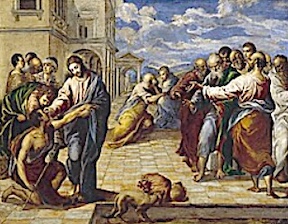
Illustration: Healing of the Man Born Blind, painted by El Greco in 1567
Pope Leo’s homily for Fourth Sunday of Lent
Parish of the Sacred Heart of Jesus in Ponte Mammolo (Rome) – 15 March 2026
Gospel for Fourth Sunday of Lent (John 9:1-41)
As Jesus went along, he saw a man who had been blind from birth. His disciples asked him, ‘Rabbi, who sinned, this man or his parents, for him to have been born blind?’ Jesus answered; ‘Neither he nor his parents sinned, he was born blind so that the works of God might be displayed in him. ‘As long as the day lasts I must carry out the work of the one who sent me; the night will soon be here when no one can work. As long as I am in the world I am the light of the world.’
Having said this, Jesus spat on the ground, made a paste with the spittle, put this over the eyes of the blind man, and said to him, ‘Go and wash in the Pool of Siloam’ (a name that means ‘sent’).
So the blind man went off and washed himself and came away with his sight restored.
His neighbors and people who earlier had seen him begging said, ‘Isn’t this the man who used to sit and beg?’ Some said, ‘Yes, it is the same one.’ Others said, ‘No, he only looks like him.’ The man himself said, ‘I am the man.’ So they said to him, ‘Then how do your eyes come to be open?’ He answered; ‘The man called Jesus’ ‘made a paste, daubed my eyes with it and said to me, “Go and wash at Siloam”; so I went, and when I washed I could see.’ They asked, ‘Where is he?’ He answered; ‘I don’t know’.
They brought the man who had been blind to the Pharisees. It had been a sabbath day when Jesus made the paste and opened the man’s eyes, so when the Pharisees asked him how he had come to see, he said, ‘He put a paste on my eyes, and I washed, and I can see.’ Then some of the Pharisees said, ‘This man cannot be from God: he does not keep the sabbath.’ Others said, ‘How could a sinner produce signs like this?’ And there was disagreement among them. So they spoke to the blind man again, ‘What have you to say about him yourself, now that he has opened your eyes?’ ‘He is a prophet’ replied the man. However, the Jews would not believe that the man had been blind and had gained his sight, without first sending for his parents and asking them, ‘Is this man really your son who you say was born blind? If so, how is it that he is now able to see?’ His parents answered, ‘We know he is our son and we know he was born blind, but we do not know how it is that he can see now, or who opened his eyes. He is old enough: let him speak for himself.’ His parents spoke like this out of fear of the Jews, who had already agreed to expel from the synagogue anyone who should acknowledge Jesus as the Christ. This was why his parents said, ‘He is old enough; ask him.’
So the Jews again sent for the man and said to him, ‘Give glory to God! For our part, we know that this man is a sinner.’ The man answered, ‘I don’t know if he is a sinner; I only know that I was blind and now I can see.’ They said to him, ‘What did he do to you? How did he open your eyes?’ He replied, ‘I have told you once and you wouldn’t listen. Why do you want to hear it all again? Do you want to become his disciples too?’
At this they hurled abuse at him: they said ‘You can be his disciple,’ ‘we are disciples of Moses: we know that God spoke to Moses, but as for this man, we do not know where he comes from.’ The man replied, ‘Now here is an astonishing thing! He has opened my eyes, and you don’t know where he comes from! We know that God doesn’t listen to sinners, but God does listen to men who are devout and do his will. Ever since the world began it is unheard of for anyone to open the eyes of a man who was born blind; if this man were not from God, he couldn’t do a thing.’ they replied ‘Are you trying to teach us,’ ‘and you a sinner through and through, since you were born!’ And they drove him away.
Jesus heard they had driven him away, and when he found him he said to him, ‘Do you believe in the Son of Man?’ the man replied ‘Sir, tell me who he is so that I may believe in him.’ Jesus said, ‘You are looking at him; he is speaking to you.’ The man said, ‘Lord, I believe’, and worshipped him.
Jesus said: ‘It is for judgement that I have come into this world, so that those without sight may see
and those with sight turn blind.’
Hearing this, some Pharisees who were present said to him, ‘We are not blind, surely?’
Jesus replied: ‘Blind? If you were, you would not be guilty, but since you say, “We see,” your guilt remains.’
Pope Leo’s Homily
Dear Brothers and Sisters,
Today, our Eucharistic celebration, today, is more in tune with joy than ever before.
In fact, the beauty of our gathering falls within the context of the Sunday known as “laetare“, which means, “rejoice” in Latin, as referenced in Isaiah: “Rejoice, O Jerusalem”. This makes us reflect.
Many of our brothers and sisters in the world today suffer because of violent conflicts provoked by the absurd claim that problems and differences can be resolved through war.
We must dialogue without respite for peace.
Some, then, even claim to invoke God in these choices of death, but God cannot be enlisted from darkness.
Rather, God comes to give light, hope and peace to humanity.
Those who invoke God must seek peace
This Sunday’s message is that beyond any abyss into which man may fall because of his sins, Christ comes to bring a stronger light capable of freeing him from the blindness of evil so he can begin a new life.
The encounter between Jesus and the man born blind can be compared to a birth.
Thanks to this encounter, the man discovers a new world.
Like a child being born, he sees himself, others, and life with God’s eyes.
Then, et us ask ourselves: What does this gaze consist of?
What does it reveal? What does it mean to “look with God’s eyes”?
According to the Gospel of John, overcoming prejudice is the first step.
Those who see a suffering man as an outcast to be despised or a problem to be avoided are closing themselves in the armored tower of selfish individualism.
We often hear phrases like: “As long as things were going well, there were many friends;
At the time of the trial, however, many have left and disappeared!”.
Jesus does not do this: He looks at the blind man with love, not as an inferior being or an annoying presence, but as a loved one in need of help.
Thus their encounter becomes an opportunity for God’s work to be manifested in everyone.
Through the “sign” and miracle, Jesus reveals his divine power.
As if retracing the gestures of creation – using mud, saliva – he restores the man’s sight, fully revealing his beauty and dignity as a creature made in the image and likeness of God.
Thus, by recovering his sight, the man born blind becomes a witness to the light.
This implies a struggle, of course: He must adapt to many previously unknown things, learn to distinguish colors and shapes, and reset his relationships. It is not easy.
On the contrary, the hostility surrounding him grows and provokes him.
Not even his parents have the courage to defend him.
It almost seems absurd that those close to him want to undo what happened.
Moreover, in the interrogation of the blind man who can see, Jesus is tried above all, accused of violating the Sabbath in order to heal him.
Thus, another blindness is revealed in the bystanders; the inability to see the face of God right in front of them.
They trade the possibility of a salvific encounter for the sterile security that legalistic observance of formal discipline provides.
In the face of such obtuseness, Jesus does not stop, showing that there is no “Sabbath” that can hinder an act of love.
After all, for the people of Israel — and for us on Sunday, the Lord’s Day — the meaning of Sabbath rest is to celebrate the mystery of life as a gift.
In the face of this gift, no one can ignore the cries for help of our suffering brothers and sisters.
In this sense, perhaps we can also be blind when we fail to notice others and their problems.
Jesus, on the other hand, asks us to live differently.
The first Christian community understood this well.
They were constant in prayer and shared everything with joy and simplicity of heart
cf. Acts 2:42-47 – 42 And they devoted themselves to the apostles’ teaching and fellowship, to the breaking of bread and the prayers. 43 And fear came upon every soul; and many wonders and signs were done through the apostles. 44 And all who believed were together and had all things in common; 45 and they sold their possessions and goods and distributed them to all, as any had need. 46 And day by day, attending the temple together and breaking bread in their homes, they partook of food with glad and generous hearts, 47 praising God and having favor with all the people. And the Lord added to their number day by day those who were being saved).
here was no lack of tribulations and obstacles, even in those days.
Strengthened by the gift of baptism, however, they did not give up.
They strove to live as new creatures, living in communion and peace with everyone.
They found a family that accompanied and supported them in the community..
Dear friends,
As children of light, we are called to bear these fruits.
For about ninety years, your parish has faithfully carried out this mission, paying special attention to situations of poverty, marginalization, and emergency.
It has also shown sensitivity and solidarity by paying attention to the presence of the local prison in its territory, among many other signs.
I know that you help many brothers and sisters from other countries become part of the community by learning the language, finding dignified homes, and carrying out honest, secure work.
Unfortunately, there is no shortage of difficulties, which are sometimes exacerbated by those who take advantage of the poverty of the weakest for their own benefit.
However, I am aware of how committed all of you are to facing these challenges through Caritas’s services,
Family Homes for women and mothers in need, and many other initiatives.
I am also aware of the vitality and generosity with which you dedicate yourselves to the education of young people and children through the oratory and other educational programs.
St. Augustine, speaking of the face of God, of whom we are called to be a mirror in the world, said to the Christians of his time: “What face does love have? What shape, what height, what feet, what hands? […] He has feet, which lead to the Church; he has hands, which give to the poor; it has the eyes with which one comes to know the one who is in need” (In Epistolam Joannis ad Parthos, 7, 10) and added, referring to charity: “Keep it, embrace it: nothing is sweeter than it”.
Dear brothers and sisters,
This is the gift of light entrusted to you.
Make it grow within yourselves and among one another, and spread it throughout the world through prayer, frequent reception of the sacraments, and charity.
Continue to commit yourselves to this mission on your journey.
May the Sacred Heart of Jesus, to whom your parish is dedicated, shape and guard this beautiful community ever more, so that it may live and bear witness to the treasure of grace that you have received with the same sentiments as Christ