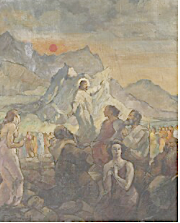
Illustration: “Sermon on the Mount” (Bergpredigt), by Friedrich Petersen (1927).
Pope Leo’s angelus reflection for 6th Sunday in Ordinary Time
St Peter’s Square – Sunday, 15February 2026
Sunday Gospel – Matthew 5:17-37
17 “Think not that I have come to abolish the law and the prophets; I have come not to abolish them but to fulfil them. 18 For truly, I say to you, till heaven and earth pass away, not an iota, not a dot, will pass from the law until all is accomplished.19 Whoever then relaxes one of the least of these commandments and teaches men so, shall be called least in the kingdom of heaven; but he who does them and teaches them shall be called great in the kingdom of heaven.20 For I tell you, unless your righteousness exceeds that of the scribes and Pharisees, you will never enter the kingdom of heaven.
21 “You have heard that it was said to the men of old, ‘You shall not kill; and whoever kills shall be liable to judgment.’ 22 But I say to you that everyone who is angry with his brother shall be liable to judgment; whoever insults his brother shall be liable to the council, and whoever says, ‘You fool!’ shall be liable to the hell of fire. 23 So if you are offering your gift at the altar, and there remember that your brother has something against you,24 leave your gift there before the altar and go; first be reconciled to your brother and then come and offer your gift.25 Make friends quickly with your accuser, while you are going with him to court, lest your accuser hand you over to the judge, and the judge to the guard, and you be put in prison;26 truly, I say to you, you will never get out till you have paid the last penny. 27 “You have heard that it was said, ‘You shall not commit adultery.’28 But I say to you that everyone who looks at a woman lustfully has already committed adultery with her in his heart.29 If your right eye causes you to sin, pluck it out and throw it away; it is better that you lose one of your members than that your whole body be thrown into hell. f30 And if your right hand causes you to sin, cut it off and throw it away; it is better that you lose one of your members than that your whole body go into hell. 31 “It was also said, ‘Whoever divorces his wife, let him give her a certificate of divorce.’ 32 But I say to you that every one who divorces his wife, except on the ground of unchastity,[h] makes her an adulteress; and whoever marries a divorced woman commits adultery. 33 “Again you have heard that it was said to the men of old, ‘You shall not swear falsely, but shall perform to the Lord what you have sworn.’ 34 But I say to you, Do not swear at all, either by heaven, for it is the throne of God, 35 or by the earth, for it is his footstool, or by Jerusalem, for it is the city of the great King. 36 And do not swear by your head, for you cannot make one hair white or black. 37 Let what you say be simply ‘Yes’ or ‘No’; anything more than this comes from evil.[i]
Pope Leo’s Angelus Reflection,
Dear brothers and sisters,
Today we hear part of the Gospel passage from the “Sermon on the Mount” (Matthew 5:17-37).
After proclaiming the Beatitudes, Jesus invites us to enter into the newness of the Kingdom of God.
To guide us on this journey, he reveals the true meaning of the Law of Moses’s precepts.
These precepts are not meant to satisfy an external religious need to feel “righteous” before God; rather, they are meant to bring us into a relationship of love with God and with our brothers and sisters.
For this reason, Jesus says that he did not come to abolish the Law, but to fulfill it.
The Law is fulfilled by love, which gives it profound meaning and purpose.
We are called to achieve a righteousness that “exceeds” that of the Scribes and Pharisees,
– a righteousness that is not limited to observing the commandments, but that opens us to love and compels us to love. (verse 20I tell you, unless your righteousness exceeds that of the scribes and Pharisees, you will never enter the kingdom of heaven)
Jesus examined some of the Law’s precepts that refer to specific situations and used linguistic formulas called antinomies to demonstrate the difference between formal religious righteousness and the righteousness of the Kingdom of God., “You have heard that it was said to the men of old,” and on the other, Jesus affirms, “But I say to you” (verses 21-37).
This approach was important because it showed that the Law was given to Moses and the prophets as a means of knowing God and His plan for us and history. In the words of Saint Paul, it was a pedagogue that guided us to God (Galatians 3:23-25).
Now, before faith came, we were confined under the law and kept in restraint until faith would be revealed. 24 So the law was our custodian until Christ came, so that we might be justified by faith. But now that faith has come, we are no longer under a custodian.
Now, however, God himself, in the person of Jesus, has come among us. He has brought the Law to fulfillment, made us children of the Father, and given us the grace to enter into a relationship with him as children and as brothers and sisters among ourselves.
Brothers and sisters, Jesus teaches that true righteousness consists of loving others, and that every precept of the Law is a call to love.
It is not enough to refrain from physically killing someone if we then kill them with words and undermine their dignity (Matthew 5:21-22 – 21 “You have heard that it was said to the men of old, ‘You shall not kill; and whoever kills shall be liable to judgment.’22 But I say to you that everyone who is angry with his brothershall be liable to judgment; whoever insults his brother shall be liable to the council, and whoever says, ‘You fool!’ shall be liable to the hellof fire.).
Similarly, being technically faithful to one’s spouse by not committing adultery is not enough if the relationship lacks mutual tenderness, active listening, respect, care for each other, and shared goals.
(Matthew 5:21-22 (above). Matthew 27-28 – 27“You have heard that it was said, ‘You shall not commit adultery.’28 But I say to you that everyone who looks at a woman lustfully has already committed adultery with her in his heart., Matthew 31-32 – “It was also said, ‘Whoever divorces his wife, let him give her a certificate of divorce.’32 But I say to you that every one who divorces his wife, except on the ground of unchastity,makes her an adulteress; and whoever marries a divorced woman commits adultery).
We could add to the examples that Jesus himself offers us.
The Gospel teaches us that minimal righteousness is not enough and that great love is needed
Together, let us invoke the Virgin Mary, who gave Christ to the world—the one who fulfills the law and the plan of salvation.
May she intercede for us and help us understand the Kingdom of God better so that we may live out its call for righteousness.