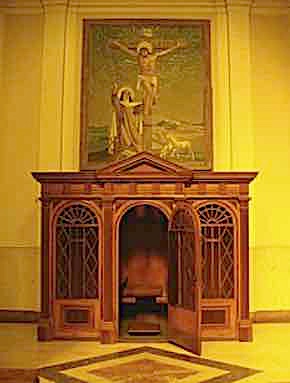
Illustration: Traditional confessional from Sicily.
Pope Leo’s address to the 36th Course on the Internal Forum organized by the Apostolic Penitentiary
Clementine Hall – Friday, 13 March 2026
“The Church Called to be a House of Mercy”,
______________________________
In the name of the Father, of the Son and of the Holy Spirit.
Peace be with you!
Your Eminence, Your Excellency, dear priests, deacons and others who accompany us, good morning and welcome!
I am pleased to meet those who are in the early stages of their priestly ministry, or awaiting ordination are refining their training as confessors, through the Course on the Internal Forum, offered annually by the Apostolic Penitentiary.
I cordially greet His Eminence Cardinal Angelo de Donatis, the Major Penitentiary; Archbishop Nykiel, the Regent; and all members of the Penitentiary, including the ordinary and extraordinary penitentiary confessors of the papal basilicas.
St. John Paul II strongly desired this course, supporting it with his pastoral passion.
Pope Benedict XVI confirmed it with his theological wisdom, as has Pope Francis, who has always taken great care of the merciful face of the Church.
I too urge you to continue in this service, deepening and broadening the formation offer, so that the fourth Sacrament may be ever more deeply known, adequately celebrated and therefore serenely and effectively lived by all the holy People of God
As we know the Sacrament of Reconciliation has undergone a remarkable development throughout history, in terms of both theological understanding and form of celebration.
The Church, as mother and teacher, has progressively recognized its meaning and function, expanding the possibility of its celebration.
However, the reiteratability (i.e. repeatability) of the sacrament does not always correspond to the baptized having recourse to it.
It is as if the Church’s infinite mercy remains “unused,” and Christians often remain in a state of sin for a long time rather than approaching the confessional with simplicity of faith and heart to receive the gift of the Risen Lord.
The Fourth Lateran Council, held in 1215, established that every Christian is bound to sacramental confession at least once a year.
This norm was confirmed by the Catechism of the Catholic Church after the Second Vatican Council and is also the law of the Church:
“Every member of the faithful, having reached the age of discretion, is bound by the obligation to faithfully confess his grave sins, at least once a year” (CIC 989).
Saint Augustine says: “He who acknowledges and condemns his sins is already in agreement with God. God condemns your sins; and if you condemn them too, you are united to God”
(In Iohannis Evangelium Tractatus 12, 13: CCL 36, 128).
Therefore, recognizing our sins, especially during Lent, means “agreeing” with God and uniting ourselves with him.
The Sacrament of Reconciliation is then a “laboratory of unity” because it restores unity with God, through the forgiveness of sins and the infusion of sanctifying grace.
This generates the interior unity and unity with the Church, fostering peace and unity in the human family.
One might ask whether those Christians with serious responsibilities in armed conflicts have the humility and courage to perform a thorough examination of conscience and confess their sins.
But – we ask ourselves again: Can man, a small and simple creature, truly “break unity” with the Creator? Is this image not ultimately mortifying of the revelation that Jesus gave us of God?
On further examination, sin does not break unity, understood as the ontological dependence of the creature on the Creator: the sinner too remains totally dependent on God the Creator, and this dependence, when it is recognized, can open the way to conversion.
Rather, sin breaks spiritual unity with God: it is a turning away from him, and this dramatic possibility is as real as the gift of freedom, which God himself has given to human beings.
Denying the possibility that sin truly breaks unity with God is, in reality, a misunderstanding of the dignity of man, who is – and remains – free and therefore responsible for his own acts.
Dear young priests and ordinands,
May you always be keenly aware of the lofty task entrusted to you by Christ himself through the Church, to rebuild the unity of persons with God by celebrating the Sacrament of Reconciliation.
A priest’s life can be fully fulfilled by assiduously and faithfully celebrating this sacrament.
In fact, how many priests have become saints in the Confessional!
I urge you too, to continue this service, deepening and expanding upon the example of St. John Mary Vianney, St. Leopold Mandić and, more recently, to St. Pio of Pietrelcina and Blessed Michał Sopoćko.
Unity re-established with God is also unity with the Church, which is the Mystical Body of Christ.
We are members of the “total Christ”.
The theme of your course this year: “The Church called to be a house of mercy”, would be incomprehensible if we did not start from the root that is the risen Jesus Christ.
The Church welcomes people, as a “house of Mercy”, because first of all she continually welcomes her Lord, in the Word heard and proclaimed, and in the grace of the Sacraments.
For this reason, during the celebration of sacramental Confession, penitents are reconciled with God and the Church.
The Church is also built up and is enriched by the renewed holiness of her repentant and forgiven children.
Dear brothers,
In the confessional, let us collaborate in continually building up of the one, holy, catholic and apostolic Church.
In doing so, we also give new energy to society and the world.
Finally, unity with God and with the Church presupposes the inner unity of persons, which is so necessary in our time of fragmentation.
The inner unity is found in the real desire of in the new generations.
Unbridled consumerism’s unfulfilled promises and the frustrating experience of freedom detached from truth can, by divine mercy, be transformed into opportunities for evangelization. They awaken existential questions to which only Christ provides a full answer. God became man to save us. He does so by educating our religious sense and our irrepressible demand for truth and love.,
Thus, we can accept the mystery in which “we live, move, and have our being.” (Acts 17:28).
This unity with God, the Church, and ourselves is essential for peace among individuals and peoples. Only a reconciled person can live unarmed and disarm others.
Those who lay down the weapons of pride and allow themselves to continually be renewed by God’s forgiveness become reconcilers in everyday life.
In them, the words attributed to St. Francis of Assisi are fulfilled: “Lord, make me an instrument of your peace.”
Dear friends,
Never fail to approach the Sacrament of Forgiveness with faithful constancy, so that you may always be among the first to benefit from divine mercy, of which you have become—or will become—ministers.
May Mary, the Mother of Mercy, accompany you on your journey and illuminate your steps always.
I cordially impart my Apostolic Blessing upon you and your daily commitment.
Thank you.