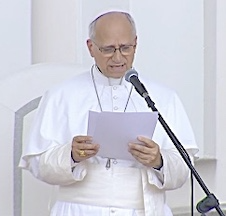
Pope Leo’s address – on the Challenges and Hopes for the Future
Square in front of the Cathedral (Lima) – Thursday, 12 November 2026
Gospel Reading: John 1:6-9
There was a man sent from God, whose name was John.
He came as a witness to the light so that everyone might believe through him.
He was not the light, but he came to testify about the light.
The true light, which enlightens everyone, was coming into the world.
Pope Leo’s Address
Dear Brothers and Sisters,
At this time, I wish to follow the example of St. John the Baptist, and bear witness to the light that illuminates everyone, Jesus Christ, the Son of God.
Let us listen to the voice of the Master, who is venerated in these lands as the Lord of Miracles, to hear what he has to say to Peru.
We cannot face challenges in isolation because family, cultural diversity, the world of work, and the status of women are interconnected aspects of the human experience.
The Church’s social doctrine provides guidelines for understanding this interconnectedness.
Created in the image and likeness of God, human beings are endowed with infinite dignity and called to live in relationship with others. Therefore, the human person must be at the center of every social, economic, and political organization.
On this basis, personal, family, and social interests unite as one.
Other fundamental principles, such as the common good, solidarity and subsidiarity, are also rooted in the recognition of the centrality of human dignity.
This principle should guide decisions in personal and family life, as well as in businesses and organizations.
Human life does not begin in a vacuum.
It is born of the love between a man and a woman who open themselves to the gift of new life, by giving themselves to each other.
A child is the fruit of this union, not a product.
From the beginning, a child bears the mark of the relationship from which he or she originates.
From the start of its fragile existence, the child is cared for in the mother’s womb,
the first place where this original bond is expressed through closeness and protection.
According to the Creator’s plan, humans are conceived and grow within this network of relationships.
This is how the dignity of newborn life is given its proper place in the family.
In light of the Gospel and in harmony with the teachings about humanity, the Church’s tradition holds that the family is the first natural community, endowed with its own rights.
This means that the family predates any written law, and that such laws should simply recognize and protect the family.
Public institutions should support the family, not replace it.
Cultural changes have certainly altered traditional gender roles.
They now embrace new attitudes and ways of living within their families and society, though they sometimes stray from the right path.
This situation requires us to proclaim with an even greater sense of commitment that God created humans as both male and female
(Genesis 1:27 – God created man in his own image, in the image of God he created him; male and female he created them.)
It is only through union that the reciprocity and complementarity necessary for fatherhood, motherhood, sonship, fraternity, and commitment to building a better society develop.
However, recognizing our identities as men and women does not justify an unequal division of household responsibilities or the subordination of one spouse to the other.
We must continue working toward harmoniously shaping the roles of men and women in families, emphasizing that they are both responsible for building the future of society.
Our faith provides an understanding of the human person that helps us overcome tensions arising from new cultural trends.
Christian charity teaches us that love means serving God and our neighbor.
From this perspective, we discover the profound meaning of being a parent, child, grandchild, or grandparent.
We cultivate dialogue, patience, kindness, forgiveness, and mutual service.
This truth deepens and becomes a fruitful source of spirituality in family life.
Each family member is called to contribute his or her gifts and talents in proper and creative ways.
Everyone is responsible for caring for others, showing tenderness, doing work responsibly, listening patiently, and teaching by example.
In this regard, I would like to draw particular attention to the many lonely and suffering mothers.
They face many difficulties in order to raise their children, ensure their healthy development, and help them grow into good people.
I would like to thank the courageous women—the mothers, aunts, and grandmothers—who pass on their unwavering faith and hope to future generations.
Many families are wounded and divided by economic problems, emigration, and addictions such as gambling, alcoholism, and drug addiction. Domestic abuse and violence also tear families apart.
God loves all families, especially those going through difficult times.
To them, I say this: Do not give up in the face of difficulties!
Consider the Holy Family, who also struggled to establish a shared home.
Like many families, they had to maintain their faith and trust in God amid uncertainty and hardship.
They moved from city to city, worked to support themselves, and endured loneliness, suffering, and misunderstanding.
However, they teach us that when God is present in a family, its members can grow together, overcome challenges, endure hardships, and experience the joy of faith.
One very relevant challenge is the impact of digital technology on families.
In my recent encyclical, Magnificat Humanitas, I pointed out that modern technology carries the risk of replacing in-person interaction and exposing family members to distractions and harmful content.
Addressing these issues requires collaboration between political leaders, educational institutions, and families.
After all, our children are Peruvian citizens, future entrepreneurs, and future workers in our cities and rural areas.
This brings us to the world of entrepreneurship, which is poised to play a significant role in promoting the common good.
To do so, legitimate authority must support entrepreneurs and workers by establishing a just legal framework that guarantees a reasonable balance between work, rest, and family life.
The durability of strong human bonds and the economic stability of families are shared responsibilities.
Recognizing the interconnectedness of life reveals that achieving the common good requires a collective pursuit of a greater good.
This ensures that society’s wealth and resources benefit everyone, not just a select few.
In this context of interdependence, education becomes a practical tool for putting principles into practice.
The key to ensuring an honest society tomorrow is educating our children today to respect their dignity.
In this regard, the state strengthens the foundations of a just and peaceful society by pursuing a social policy that recognizes the equal dignity of all people.
This policy supports families and provides educational programs that foster students’ intellectual and personal growth.
The state also implements employment policies that safeguard the dignity of work and private initiative.
Recognizing the importance of human dignity also improves our understanding of cultural diversity.
Peru is an extremely beautiful country because due to its cultural, linguistic, historical, and regional richness.
As we sing in one of the Creole sings: “Mountains full of riches, beautiful lands; smiling beaches, fertile lands; snow-capped peaks, rivers, gorges. This is my Peru!”
Differences foster encounters and mutual enrichment.
It is precisely because we are different that we form a “common unity,” or community.
However, as with any group of people, historical wounds and mistrust can sometimes make understanding each other difficult.
Statements or behaviors that classify, insult, or judge people based on their appearance, origin, or social position under the guise of “jokes” or colloquialisms are unacceptable. In addition to disarming language by giving up hurtful words, we must also disarm our attitudes.
Aggressive attitudes are disarmed with meekness. Jesus himself exhorts us: “Learn from me, for I am meek and humble of heart” (Matthew 11:29).
Meekness is not weakness, but an inner strength that restrains anger and resentment, transforming them into patience, dialogue, and a willingness to reconcile.
Jesus perfectly exemplified this virtue during his Passion when he did not respond to insults with violence or threats.
Let us pray that we may reflect the light of Christ, “the sun that rises from on high” in the Empire of the Sun – Intipa imperion –(Luke 1:78).
In this context, we cannot forget St. Turibius of Mogrovejo, who preached the Gospel to different peoples speaking different languages without imposing it by force.
He confronted the challenges of peaceful coexistence, unity, and communion in Christ.
Cultural diversity can be a tool for building peace when we view those who are different from us as brothers and sisters who deserve respect.
Unity in diversity is the work of the Holy Spirit and a reality we must cultivate to become signs of unity in Christ.
The Catholic Church embraces the whole world while also assuming the characteristics proper to each place.
As the Catechism of Lima attests, the Church speaks in all languages.
Recognizing human dignity also requires supporting the presence, respect, and participation of women.
Their contributions to all areas of social and ecclesial life are invaluable.
Sadly, the macho mentality persists.
This mentality is evident through the absence of fathers in family life, abuse and violence against women, and the disregard for the novel Christian idea that women and men have equal dignity and responsibilities.
Women living in poverty or belonging to indigenous or African-American communities may experience double marginalization.For this reason, we are painfully aware that violence against women—who could be our grandmothers, mothers, sisters, or daughters—hurts all of humanity.
I would like to renew my fervent appeal not only to my brothers and sisters in faith, but also to every man and woman of goodwill. Let us value women!
Let us protect girls and show them respect!
The Church values the unique qualities of women, as exemplified by the Virgin Mary. She is considered “the new woman and the perfect Christian” because she embodies the most defining aspects of women’s lives.
The Gospel portrays her as a strong, independent woman committed to imitating Christ and promoting the Church’s mission.
Brothers and sisters, therefore, the family, entrepreneurship, cultural diversity, and women’s roles are united in one common task: building a society in which everyone can live with dignity and contribute to the greater good.
While just structures are necessary, they are not sufficient for the good of all.
Just structures are necessary but not sufficient.
To overcome corruption, violence, and individualism, we need people with honest hearts who are committed to the common good.
As missionary disciples of Jesus Christ, we should transform our homes into schools of fraternity, our workplaces into communities of social responsibility, our cultural differences into opportunities for connection, and our institutions into spaces where women and men can participate in and contribute to society.
In doing so, we move towards a more just society, one in which the dignity of every human being is the foundation of true peace.